Showing posts with label J.R.R. Tolkien. Show all posts

Wednesday, April 29, 2015

Big, long, and totally worth it


So let's get this out of the way right off the bat: Lord of the Rings is amazing and I love it, it's one of my favorite books and when I was eighteen I constructed a tattoo out of the Elvish alphabet that I still love (though I had to sit down and re-translate it after reading the novel this time because I hadn't really looked at it in years). I fucking love this book. It is fucking rad. Now...

That doesn't mean that it's without problems, though. Women are underrepresented and non-whites are only present as antagonists and villains. Because it was written by Tolkien and because he had some very specific intentions for his history of Middle Earth I can largely let that pass by (also if you want to read a bunch of cool stories about women by Tolkien you should check out The Silmarillion). Rereading this time around I was particularly struck by Eowyn's false dichotomy in the narrative she's set up for her life. She really is very one-dimensional and more flawed that I had realized. And Arwen basically doesn't speak in the novel. She's mentioned a couple of times, says very little at a fancy dinner, and that's it. You don't get to know her at all in the book. Goldberry and Tom Bombadil become more perplexing and silly the older I get - they don't make any damn sense. Lobelia Sackville-Baggins comes off looking pretty decent in this reading, though. She was a tough and admirable little hobbit.

There's a ton of stuff that's really good, though. I keep forgetting how much humor there is in the novel - the fellowship speak to each other in exactly the way you'd imagine a bunch of stressed-out people on a road-trip would: there's tension and fear, but also a lot of wise-cracking and absurdity. Treebeard and the Ents are quite funny, in their slowness to anger and roundabout way of speaking. Merry and Pippin are, of course, hilarious, as is Gollum in his own creepy way. And you grow to know and love the characters very quickly - Tolkien wrote them all as interesting, multifaceted people. They're all flawed, from Boromir's weakness before the ring to Legolas's weariness of the world, to Aragorn's fear of claiming his birthright. Except maybe Sam. Sam is pretty much perfect and I'm not sure anyone could convince me otherwise. Any hobbit who could reject the power of the ring to make the whole world a garden for himself is a hobbit made of stern stuff.

And then there are the appendices. I had flipped through them before to track down the linguistic information for my tattoo but I had never read them. I planned to skip them this time around too, but chanced on the story of Arwen and Aragorn (in which some of the pieces the novel was wanting are found) and decided to read through it: I was duly sucked in to reading the additional hundred or so pages that end my single-edition copy of the book because HOLY SHIT there's so much good story in there. I don't know if the appendices weren't finished until later editions or if they were just cut for length or if Tolkien didn't want to take more time in an already long story to tell less important stories, but I wish that at least part of the appendices had ended up in between the pages of the novel instead of tacked on at the end because they really do make it a better book.

I enjoyed reading LotR, as I always do. It will always have it's problems, too, but they're never so large that I can't get over them and put myself back in Rivendell or on the path to Mordor again.

Cheers,
     - Alli

Tolkien, JRR. The Lord of the Rings. Houghton Mifflin. Boston: Massachusetts. 1991. (1954).

Wednesday, April 15, 2015

Ever on


Good books are repeatable. The best books are endlessly repeatable. I don't have any idea how many times I've read The Hobbit at this point in my life but it wouldn't surprise me at all if that number was above fifty.


This time around the novel was even easier than it's always been - I raced through it and it felt like coming home. I couldn't get Middle Earth out of my head after finishing The Silmarillion and so The Hobbit was the next obvious choice (at least in the chronology of the major Middle Earth books). I can't tell if it's just that Bilbo's story is so much easier to read than the tales of the Elves, or if it really is a very simple book, or if I've just read the book so many times now that I don't really have to focus on the words to get into the story. Honestly I don't think it's any of those things - I think The Hobbit was fun and easy to read this time around because I wasn't scrutinizing it the way that I did last time. The movies are out, they're over, I've seen them all, and I don't have to watch out for things to criticize in any upcoming adaptations so I could just let Hobbiton and Mirkwood and The Lonely Mountain wash over me with nothing hovering inside my thoughts but sheer enjoyment of the story.

The book has the same minor problems that it has always had and will always have simply because it was a product of its time and place - it's not terribly representative of anything but white males - but that's no reason to ignore this wonderful story and appreciate it for what it is. It's funny, it's sweet, it's exciting, and it's full of action, adventure, and really wonderful sentiments about friendship and bravery.

The Hobbit isn't a perfect book - I don't know that perfect books really exist - but to me, at least, it will always be one of the best books, and I will always love coming home to it.

Cheers,
     - Alli

Tolkien, J.R.R. The Hobbit. Ballantine Books. New York: New York. 1973. (1937).

Monday, April 13, 2015

Myths mastered at last


I think I was about twelve years old the first time I tried to read The Silmarillion. I failed miserably - maybe ten pages in I fell asleep. For the next few years I used the book as a sleep aid - I kept it by my bed and never got past the music in the darkness before it knocked me out.

I fared a little better at twenty and managed to push through at least until the real story started, then I decided that the book was too boring and put it down again. At twenty-five I managed to get through all but the last thirty pages of the book; I got past the story of the Silmarils but just couldn't keep going so I set the book aside to take a break and didn't pick it up again.

Now, finally, sixteen years after I first started trying to read this damned thing, I've finished The Silmarillion and I fucking loved it. I totally understand why I had trouble reading it through all these years, because it's 300 short pages are about as dense as a neutron star, but I'm really pleased that I finally pushed through and got the damned thing read.

To be 100% honest and transparent, I'm a huge, unwieldy Tolkien geek. My dad read The Hobbit to my sister and I as children and it's the first book that made me want to read. I chose to do a book report at 11 on LoTR because it was way above my grade level but I HAD TO KNOW WHAT HAPPENED. I kept pushing to try to read The Silmarillion because I'm one of those people who showed up to midnight premiers wearing a cloak and I own a pair of toe socks with hair on top for when I'm feeling particularly nerdy. I read this book because I couldn't let it go. Middle Earth is more my home than most places I've been on actual Earth and I want to know all their is to know about it. If you are NOT at Tolkien geek on a dressing-up-in-public level then I would NOT recommend this book (unless you've got a serious hardon for mythology in general, in which case you should read it and we should hang out because mythology is AWESOME).

The history of the Valar and the Eldar and the Edain is long, complicated, and full of characters who each have three names that are only one letter or syllable removed from the names of their ten siblings (who each also have three names). The Silmarillion is not hard to read because it's depressing, it's hard to read because it has about a thousand characters and most of them have lifespans at least 500 years long. The scenery physically changes so that a castle that existed in an early part of the book was on a mountain range that's under water in the late part of the book (and each place also has 3-7 names that sound incredibly similar to all of the other places around it and the character names). What I'm getting at is that this is not a light, fun, easy read that you can blow through in a couple of hours: it will kick your ass and take your name and confuse you in quite a few places but it is still TOTALLY WORTH IT.

Linguistically the book is fascinating, as a mythology it's terribly impressive, and to Tolkien geeks who want to get to know Middle Earth on a more intimate level it's indispensable. But to casual Tolkien fans who liked the movies and maybe read The Hobbit but had trouble with how much singing everyone did in LoTR, The Silmarillion is probably not going to be worth the effort to read it.

(But you should try anyway because, seriously, it's so good.)

Cheers,
     - Alli

Tolkien, JRR. The Silmarillion. Christopher Tolkien, Editor. Houghton Mifflin. New York:
     New York. 2001. (1977).

Friday, December 13, 2013

A little book turned into a lot of movie

The Hobbit: An Unexpected Journey

When I first saw Sin City I was struck by how bad a movie could be while completely adhering to the source material. Books and comic books frequently have images and moments that don't hold up well to being filmed. In Sin City it's mostly a dialogue problem - characters say things which work really well on the starkly fantastic pages of the comic book, but which sound hilariously implausible when spoken by an actual human being. In The Hobbit: An Unexpected Journey, the song is the problem. You know which song I'm talking about. The one with the acrobatic plate-flinging. The Hobbit is a significantly more childish book than The Lord of the Rings, and does include some very silly songs and funny narrative commentary, but a lot of that comes out looking ridiculous in the movie when you're looking at serious actors preparing to embark on a dangerous, three-movie adventure.

The song is just the first of some really odd choices in a movie that's looking for a genre. The Hobbit badly wants to be a LotR film, but it also wants to be a children's movie, and a character piece for Bilbo Baggins. Peter Jackson tried to do all of this and unfortunately it just didn't come out very well. The choice to include the cups and plates song, but not to include the jolly singing elves is confusing. The decision to add a comedy beat at the end of the goblin chase is perplexing when you've spent 10 minutes watching the weird sexual tension between Galadriel and Gandalf as they argue with Elrond and Saruman in the slowest scene in the film. What is so frustrating is that you can't make an argument that this is the result of Jackson being a Tolkien purist - the inclusion of Azog and Thorin's back story is neat, but it's only one line in the original novel. It's great to see Radagast on screen, but nowhere in the books is there any suggestion that he's the 'head we see in the movie (and it's really frustrating to see a character who's written as a St. Francis of Assisi analogue played for laughs like he's in a Cheech and Chong bit).

I also noticed an irritating plot hole when I rewatched this last night - Radagast mentions to Gandalf that a shadow has fallen over the forest, and that "some have even come to call it the Mirkwood"; I'm going to be a pedantic geek here - if Gandalf went to Dol Guldur in the 2063rd year of the Third Age (the same time as our quest) then Greenwood the Great had been know as Mirkwood for over a thousand years. In LotR Legolas uses the name Mirkwood for his home forest - and since elves are stubborn and stuck in their ways and calling it Mirkwood long after the Necromancer has been driven out, it is unlikely that Radagast would have to reveal with horror to Gandalf that men are calling the forest Mirkwood and to have him do so just so they get to throw in a line about how creepy the forest has gotten is an idiotic reason to mess with the plumbing of the universe.

All of that being said, there are some truly wonderful things about the film. Martin Freeman's Bilbo is effortlessly delightful, and the tensions between him and the dwarves are not only accurate to the novel but interesting to watch and powerfully moving. Andy Serkis reprises his role as Gollum (and steps in as Second Unit Director) before the trials of Mordor; he is creepy and pathetic, and incredibly compelling. The relationship between Bilbo and Thorin is developed at just the right pace and with just the right pathos. And, of course, Peter Jackson films Middle Earth like it's his lover.

Which brings us to another problem - it seems like technology might finally be getting too good to be true. When the LotR came out, no one had anything but compliments for the CGI; when The Hobbit first premiered not only was the CGI criticized, the whole film was criticized - high frame rates served to make all the animation look cheap and all the actors look terrifying; only the beautiful landscapes and backgrounds of Middle Earth saved the visuals of the film. Seeing it last night in IMAX 3D only made it worse - the high frame rate is jarring and makes what I'm sure were very expensive visual effects look very cheap (hint: if the series you're filming involves a dragon, you don't want to do ANYTHING to make your CGI fire look cheesy).

The long and short of it is that I very badly want to like this move, there are large parts of it that I do like, and a second viewing has improved my opinion of it, but due to some strange choices I don't think that I'll ever enjoy it the same way I enjoy The Two Towers (immensely, and every chance I get) or even the way that I enjoy the Rankin/Bass 1977 cartoon (with fond nostalgia and a vague need to buy the DVD). Maybe I'll watch this move once in a while, but I don't think that I'll feel the need to immerse myself in it regularly, which is sad because that IS something that I feel for the book, as well as for the LotR films.

The Hobbit: The Desolation of Smaug
(Spoilers Below! I guess? It's an old book. I'm not sure I believe in spoilers for books this old.)

There's a huge problem with being an obsessive geek - I enjoyed the hell out of this movie, but I kept thinking "but that's not how it happened in the book!" because I am a jerk and I don't like change.

There aren't a ton of problems with the changes that they made; the introduction of Bard works really well, truncating the Mirkwood experience is probably necessary, singing at the spiders might come off as ridiculous (even thought I wanted to see that SO BAD) so I guess it was safe to leave out, and showing us Gandalf's timeline does a good deal to increase tension and provide a sometimes-needed break from the 13 dwarves.

But some of the changes from book to movie really, really bothered me. I'll limit myself to one example, but it's a big one: only Bilbo should interact with Smaug. That's something that I think is key to the story - Bilbo faces the dragon alone and the dwarves are less interested in a tête-à-tête for the sake of vengeance than they are with letting Bilbo burgle. Smaug isn't completely right when he tries to convince Bilbo that the dwarves are letting him take all the risk while they get all the money, but he's not far wrong either. Tolkien wanted to emphasize that contrast - dwarves aren't human, dwarves aren't elvish, and dwarves aren't wizards - dwarves are dwarvish and have a different way of doing things, a way that is sometimes harsh but usually pragmatic; but you don't get the contrast if you have the dwarves fight Smaug for a quarter of the film. In the book, dwarves are kind of assholes - these movie dwarves are a bit too cuddly and broad-minded, which concerns me because some of the action coming in the next segment of the story relies on dwarves being assholes.

It's pretty typical of me to worry about things that haven't happened yet, so I'll leave off speculating as to whether or not the dwarves are big enough jerks and move on to other things.

Someone save us from high frame rate and the renaissance of 3D. I don't like it, it's incredibly distracting, and it detracts from my enjoyment of the film. This time the animators got it right and Smaug is probably the best looking thing in the movie, which is pretty sad because we're talking about a movie filmed in New Zealand - every exterior scene should be ball-crushingly beautiful, but it's not because you can't really see it because your eyes are overwhelmed with the hyperclarity of the high frame rate. It makes everything look flat and dull and too bright at the same time. This is a Peter Jackson Middle Earth movie with a huge budget, but high frame rate makes it look like a cross between a basic-cable daytime special and an overproduced videogame. There's a sequence that takes place in a river; it looks like it was filmed on a GoPro - this isn't Middle Earth, this is the over saturated video your drunk brother shot while kayaking. The images jump from having no depth of field to having a vertiginous, fathomless depth in seconds. It is dizzying and it literally made my eyes hurt. (This could be a problem with my eyes since I have very little depth perception in the real world, which is part of why I like movies so much - someone else is doing the focusing for me).

For all my bitching, though, I did really enjoy the film. Last year when Unexpected Journey came out I walked out of the theater saying "I don't know how I feel about what just happened." Last night I walked out of the theater and said, "yeah, it has some issues but that was rad! Wanna see it again?" I do think that I'll see if again, but I think I'll try to find a 2D 24fps version so that I can give my eyes a break and really take it in without having to blink hard every few seconds.

One final note: my dad and sister are convinced that Peter O'Toole would be the perfect person to voice Smaug, and I don't disagree with them, but any concerns about Benedict Cumberbatch were totally groundless - he has a TERRIFYING voice and it's fantastic for the chiefest and greatest of calamities.

So, you should check it out, and after 5 hours of late-night Middle Earth, I should take a nap.

Cheers,
     - Alli

Sunday, December 8, 2013

Of hobbits and humanity

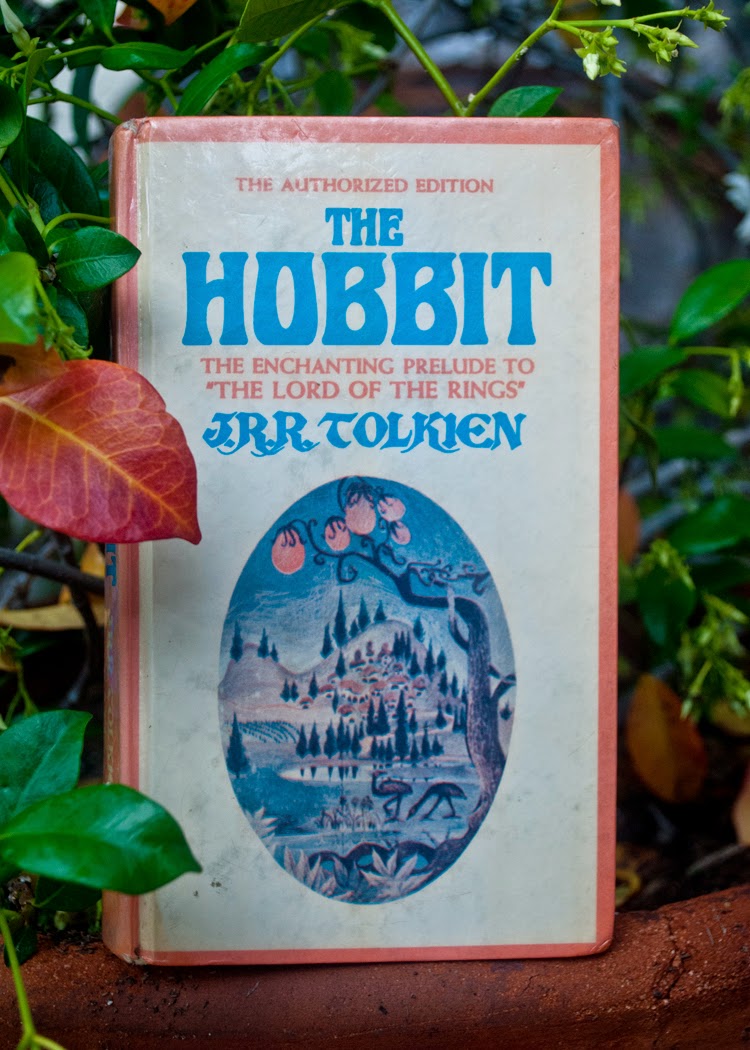
The Hobbit with brass buttons. Photo by Alli Kirkham
 
"In a hole in the ground there lived a hobbit. Not a nasty, dirty, wet hole, filled with the ends of worms and an oozy smell, nor yet a dry, bare, sandy hole with nothing in it to sit down on or to eat: it was a hobbit-hole,  and that means comfort."

My copy of The Hobbit comes to me third-hand; first it belonged to the Alhambra High School Library, then to my father who bought it when the school library had a book sale, and then to me (with a library checkout card still glued neatly inside the front cover. It is the first book I remember having read to me at bedtime, the first story I really connected to. My dad would read a few pages to my sister and I every night - the three of us would sit on my bed (my sister and I snuggling under the covers, much warmer than poor Bilbo for most of his adventure) and for half an hour or so each day we were all transported to Middle Earth, finally settling down to sleep dreaming of elves and dwarfs and roads untold.

I adore Tolkien. I have a Tolkien-based tattoo. I went to the midnight premieres of each Lord of the Rings film in full hobbit regalia. I have watched the Ralph Bakshi LotR films a few times and the Rankin/Bass Hobbit film innumerable times. But for me it all comes back to this little orange paperback book with yellowing pages and a fading cover illustration - this is the book my dad read to me, this is the first real book that I remember reading.

The Hobbit is, at its core, a children's book. It is the story of a wonderful adventure with unlikely beginnings and an even more unlikely hero. The language is simple, fresh, and surprisingly funny through the whole length of the novel. The book introduces you to a delightful array of characters, with its troop of dwarfs and hordes of goblins; this is where we meet the Bagginses and Gandalf and Gollum, where we first encounter Elrond and start to have the great names of this universe laid out for us.

It is not an introduction to Lord of the Rings, not a simple post-script to The Silmarillion. This is an amazing, complete, moving novel all on its own. The depth and complexity of The Hobbit is, like so many things within the story itself, unexpected. It is a deeply human book in spite of the fact that the race of Men is so frequently absent from its pages.

What struck my mind most on this rereading was the discussion of war; not the Battle of Five Armies, which is the only war that happens in the story, but the tensions before the battle - when good folk lose sight of their goodness for a while. The Hobbit has much to say human frailty, and about those things that divide even the best of us from our better nature. Heady stuff for a children's book but lessons worth learning, and worth learning young.

There is magic in all stories, and particularly strong magic in good stories. It can change who you are and who you want to be. The Hobbit is full of the best kind of magic; it makes you long for adventure, teaches you to fight for what is right, and, once you have read it and known its lands and people, becomes a part of you forever.