Okay, right off the bat let's get this out of the way: Jane Smiley's A Thousand Acres is King Lear told from the perspective of Regan and Goneril (Rose and Ginny). That's fine, but I actually want to approach the book independent of the Lear connection.
The writing is pretty dang great, honestly. I was expecting the book to be dull and slow but I read the whole thing in a single sitting - it was really engaging and brilliantly paced; it also has this stellar midwestern gothic thing going, you know, swaying corn and abandoned charity shops and churches no one really wants to go to. The grimness and drudgery of farm work and the incomprehensible multi-generational dedication to it.
I kept feeling like the book was familiar and it wasn't the Lear thing, it was Stephen King's 1922 and Truman Capote's In Cold Blood. It turns out that "something evil is lurking in she barn" or "these fields have many secrets" is an aesthetic that I'm super into. Smiley does that aesthetic really well and the faded mysteries of the junk pile and shimmering heat of the fields are tangible and harsh, as is the driving wall of water from the unexpected storm and the cool earthen rot of a cellar unknowingly housing a poisoned pill.
Nice.
There's an unsatisfying tension at the end of the novel and I think it's actually pretty brilliant. Things aren't neatly resolved, people aren't happy ever after. That kind of makes it stick. I finished this book about three weeks ago but it's been in my head enough that I've been considering rereading it ever since.
Anyway, strong recommend.
Cheers,
Alli

Showing posts with label Novel. Show all posts
Showing posts with label Novel. Show all posts
Monday, August 27, 2018

Thursday, August 2, 2018
Something moving in the trees
Okay look, Twin Peaks is great and I love it but it's a messy series that has huge continuity issues and that I'm not sure its creators really understand.
And for sure, a hell of a lot of the fans don't understand it and I don't fault them at all for not wanting to delve into twelve supplemental novels.
If you want the bare minimum Twin Peaks experience just watch the original two seasons. That'll do it, that's a totally valid way of consuming the series and it's a warm nostalgia bath of sweetness and horror.
Or you can get fucked up and actually read the books.
The Secret History of Twin Peaks and Twin Peaks: The Final Dossier go a long way toward making the most recent season of the show comprehensible, but they're also fucking bugshit crazy and have no problem with warping and twisting Original Series canon. (Best example of fucking with canon: the divergence between the book version and the show version of Ed and Nadine's marriage - and Norma's homelife and family get a hasty band-aid that tries really hard to make sense but just kind of doesn't).
Also Secret History is basically all about aliens, which is my least favorite part of the TP lore. It gets better toward the end, but it's a big heavy book full of disparate sources and difficult-to-read pages that's mostly about the alien-filled escapades of a character who gets like five lines in the original series.
The Final Dossier sheds a lot of light on what exactly the fuck was going on in The Return, which I liked and appreciated a lot - though this one got worse toward the end.
Some questions are answered but David Lynch seems to like leaving a lot open-ended. There are still gaps to fill in, there are still mysteries left behind in the wake of reading these novels.
I enjoyed both books to an extent but was also frustrated by both. Only read if you're super obsessively, unhealthily, into Twin Peaks.
Like me.
Thursday, July 12, 2018
Dodos died for a reason - they were too slow
Hey so The Rise and Fall of D.O.D.O. was the first book I started reading this year and it took me until July to finish it because I fucking hated it.
Which is a little shocking considering my well-documented appreciation for Neal Stephenson. Nicole Galland co-authored the book and while it's tempting to blame her for what I didn't like that's not really fair because a) I've never read her other stuff and so I couldn't tell you if I like her style or not and b) most of what I didn't like felt like Stephenson bits that weren't landing.
I really dig maximalism done well but this felt like maximalism done badly - it became a slog, it got boring.
Maybe that was because it was supposed to be a journal and collection of documents and the bits of Stephenson's style I like the most are in the narration. Maybe it's because the majority of the book is from the perspective of a character who I feel is really poorly written. Poor Dr. Stokes. I wanted her to be really well written, I wanted to like her - it's clear she was supposed to be sympathetic but she was written as indecisive and insecure and passive-aggressive in a way that was really frustrating to read.
Also the big bad of the book feels poorly developed and everything sort of dissolves into a nonsensical rush in the last 50 pages. Plenty of people have talked about Stephenson's denouement allergy and the fact that he likes to cut things off right after the climax and maybe this book illustrates why that's the case - everything after the last big action scene was kind of shit.
Anyway, long story (and jesus it was around 800 pages and it was a slog for once I'm sympathetic to people who think he's long-winded and dull) short I didn't like this book and actively resented the time I spent reading it and should have stopped after the first hundred pages didn't grab me because I don't feel any better having finished it except that it won't drive me crazy for not making the effort.
Fuck this book.
Saturday, March 31, 2018
Creeping in Castle Rock
Is Gwendy's Button Box the first Castle Rock story in the Kingiverse that's co-written? I'm not sure and at the moment I don't want to google it, but the novella is a creepy little tale by Stephen King and Richard Chizmar that I both enjoyed and was horrified by, which is the best that can be expected when you're dealing with King.
The story is uncomfortable in that it makes you feel the weight of responsibility put on our titular Gwendy, and as she grows familiar with the eponymous button box so do we - it's an object of obsession and control and we become nervous about its use and fate.
The book is short, which places it in a good position relative to some of the other Castle Rock stories. I think the novella format is perfectly suited to our jaunts to the creepy little town. The Body and Sundog are stronger works than Cujo, certainly.
It may well be that Castle Rock is such a known quantity (though not monstrous like Derry) that we don't need to get to know the setting - all you have to understand is that the story takes place in the sleepy little village and you already know the history of misery behind the place.
Bad things have happened here but it is not a bad place.
Anyway Gwendy herself is fantastic and I'm always happily horrifed when we get a visit from the dark man. I never know what Flagg is up to but I can rest assured that nothing good is going to come of it.
Which is exactly what happened here and why I'd recommend picking up the book to see what's going on for yourself.
Cheers,
- Alli
Wednesday, December 27, 2017
Old-timey racism still isn't cute
Okay, I'm reading some Wilkie Collins because of a Stephen King book. In The Long Walk one of the characters is dying and mentions that The Woman in White is his favorite book and since I read The Long Walk for the first time I've wanted to read The Woman in White.
But it wasn't available as a free e-book until recently so I read The Moonstone instead.
The book is fine? Like the story is fine and I'm actually pretty pleased with how the narrative structure was arranged. That's peachy.
But oh wow is it kind of pretty damn racist. I mean hey, yeah, big surprise, here's a book written by a white British Victorian dude, who would have thought he'd be pretty fucking rude about Indians? Yeah.
The plot of the novel is compelling, unfortunately it's rooted in the idea that three "savage" Indians are tracking down a gemstone that was stolen from their sacred temple as a war trophy and that the "savage" Indians are wholly in the wrong here.
This would be *so* easy to fix by making it a haunted gemstone, or a gemstone belonging to a local conniving duke whose sons are tracking down their ill-gotten gains or whatever. But that's not what happens and so we can't really get around it.
I enjoyed significant parts of this book, it can be extremely funny. But it isn't commenting on the harms of racism and imperialism, the way that Twain did, it's reveling in the idea that pure, virginal British women are threatened by foreigners motivated by mysterious magic.
And that just kinda sucks.
Cheers,
- Alli
Monday, August 14, 2017
Learning to live with death

For years now people have been telling me that I need to read Terry Pratchett and unfortunately it just kept getting pushed to the back of my mind over and over and over again. It felt like jumping into Stephen King for the first time - there's so much that he's written that I didn't know where to start. When Pratchett died in 2015 someone asked Neil Gaiman on Tumblr what they should read first if they wanted to read Pratchett's work and Gaiman recommended Mort. I bought the book that day and it sat on my shelf for two years while I worked through things higher up on the to-be-read list.
Now, I'll say straight-up that I liked the book, but I don't think I'm going to end up with a Pratchett collection the same way that I have a King or a Gibson or a Stephenson collection - I've got nearly all those other guys' books and have read almost all of their books somewhere between five and seven times at least. I liked Mort, I had a fun time reading it, but I think Pratchett might be an almost-perfect author to use my library card with.
Mort was a rapid read, lasting just a couple of hours. The writing is simple but bitingly funny, the universe is expansive and fascinating, but unfortunately I still don't really feel like I know enough about it to sink deeply into it. The book did make me want to read a lot more Pratchett, I enjoyed the mythology of the world and the tone of the writing enough for that, to be sure. But I feel like I want to do a deep dive into the Pratchett that's out there before I make a commitment to buying dozens and dozens of books.
Anyway. Mort. It's a funny book about Death, Death's Apprentice, Wizards, and how everyone has to follow rules in some way. As a first look at Discworld it's enough to tantalize but not enough to really get to know the place. I was pretty happy with most of what was happening in the novel but it did feel a bit clunky in places, most of which had to do with romances feeling really stilted.
I hope to explore more Pratchett in the future, I hope I enjoy return visits to Discworld, and I agree with Gaiman - Mort is a good book to get your toes wet and see if the Pratchettverse is worth exploring.
Cheers,
- Alli
You can buy Mort, which was published in 1987, by clicking on this sentence.
Thursday, July 27, 2017
Whining and dying

Ohhhhhmygod this fucking year.
Okay. So I basically didn't read any books in June, I started reading Our American King but then got distracted and very, very fucking busy and that's kind of where I still am only I've finished reading a couple books but now I'm super behind on blogging about them and I haven't made a video rundown since fuggin APRIL.
Like the good news is I've started a Patreon and an Etsy store and have purchased a domain for my webcomic and have been working on submitting to anthologies and such.
The bad news is that I don't get as much time to read and I don't get as much time to write about what I've been reading so that's where I'm at with this blog.
I mean, it's not going to *stop* me or anything, I've just gotten really good at constantly functioning with some low-grade, background panic going on.
Anyway, David Lozell Martin's Our American King is depressing as fuck and I really have to stop accidentally stumbling into reading dystopias because in other years I love that shit but right now I just cannot hang with a story about a military takeover of the US after some unnamed catastrophe. TOO UPSETTING.
The book was generally fine, there were a couple things that were genuinely compelling and made me want to know more but like I'm just not super in the mood for rape and starvation and might=right at the moment. The latter half of the book has some things that it wants to say about the petit bourgeoisie and resource hoarding but I don't know that it said it all that well, or at least it doesn't seem all that well said when the US seems pretty amped to eat the rich at the moment.
(Like, they're talking about rich people in Arizona walling themselves away from the poor and sneering down at their suffering - I read this the same week that John McCain flew away from his hospital bed to vote to overturn the ACA. MAYBE SAVAGE MURDER OF EVERYONE INVOLVED DOESN'T SEEM THAT BAD TO ME BECAUSE OF MY PREEXISTING CONDITIONS BUT FUCK IDUNNO)
Anyway, if nothing else it's super weird to look at the grim perspective of only 9 years ago and say "welp, it didn't go that way but maybe it went worse."
Because it's hard to read a book about an exhausted population looking to a charasmatic liar to lead them away from democracy from the perspective of someone living in the time of 45.
Fuck.
David Lozell Martin's Our American King was written in 2008 and can be found wherever.
Wednesday, May 31, 2017
I should probably stop reading genres I hate
Ugh, a murder mystery that's also a romance? Why did I think this was a good idea.
Because it was free. That's why I read it. And because I was in Vegas with my mom and needed something to hate-read in my down time.
And The Lavin Murders was, for me, a perfect hate-read.
It's a perfect mish-mash of all the traits I hate in mystery novels and all the traits I hate in romance novels (though it's not a romance novel, it doesn't get steamy or sexy, there's just a slow-burn love story that does a bad fucking job of it). The bad mystery aspects include things like cops dismissing the spunky "little lady" leading the story, a vast conspiracy, and a protagonist who doesn't suspect that the titular Lavin Murder is a murder in spite of finding the corpse of a customer wrapped in a fur coat behind the counter of her store that she had locked and unlocked herself.
Seriously, it takes like fifteen chapters for our martini-loving, vintage clothing-wearing heroine to start to wonder if perhaps her dead friend who mysteriously appeared in her store and had suddenly, forcefully, and unexpectedly demanded the return of the coat her body was wrapped in, might have died as the result of foul play.
The book is largely an excuse to talk about fancy clothes, and I don't begrudge it that, it's the one thing the novel does well. I wanted to google some of the designers whose names popped up in the pages, and sketches of the outfits described would probably look stunning. But I couldn't bring myself to care about the conflict between our protag and the mean rich lady opening a store down the street just to fuck with her, or the protag's strained ongoing friendship with her aggressively misogynist ex, or the protag's budding romance with the tall strong and unconventionally handsome handyman who wears vintage flannels passed to him from his uncle.
The whole thing is just kind of insipid and dull. I found myself continually rolling my eyes and shouting at my kindle. I hate the classist assumptions of the protagonist we're supposed to agree with. I hate the ostensibly pro-sex-work but really well-of-course-that's-why-she-got-murdered attitude. I hate that (spoilers) the plot turns out to be about the exploitation of Native American land rights by the big bad and that our white-as-fuck protag and her white-as-fuck boyfriend have to come in and rescue a Native American character and be the heroes.
For being such a shitty little novel it was full of fascinating tensions that I don't know if Angela Sanders herself was aware of. Protag's ex boyfriend is a liberal politician's right-hand-man and is a shitty, gaslighting, mansplaining douche - her budding romance is with a working-class man who has family in prison and butts heads with the main officer investigating the case because the cop knows he's from a group of rough hombres, or whatever. Protag goes to a political fundraiser at a rich lady's house at one point and there's a fight between Protag and another vintage clothier and Protag ends up hanging out with the catering staff. THERE'S SOME INTERESTING STUFF ABOUT CLASS HERE. THAT'S KIND OF COOL AND SEEMS LIKE SOMETHING YOU COULD SPEAK TO IN A WAY THAT DOESN'T DEVOLVE INTO "Well, this little princess wandered into our dive-bar, we're going to sneer at her until she proves herself." Same with the misogyny of the liberal politicians opposing the egalitarian attitudes of the working class. Same with the too-brief explorations of sex work and Native rights and gentrification.
I get that it's supposed to be a fun fast-paced thriller about fashion and murder, but if it's supposed to be fun maybe don't take fifteen fucking chapters to have the protagonist lounge around her apartment making martinis and thinking of how much she'll miss her friend who mysteriously died in Protag's own store before our intrepid heroine starts to think it might be murder.
Jesus fuck. Pacing problems and milquetoast progressivism plagued this novel, which I suppose is perfectly apt considering its Portland setting.
Ugh. I guess if the other books in this series came up free from the Kindle store I might download them to hate-read some more but there's no way in hell I'm paying for them.
Fuck.
Cheers,
- Alli
The Lavin Murders by Angela M. Sanders.
Tuesday, February 28, 2017
Nazi punks fuck off

I'm just going to start by stating that I, personally, stand behind the punching of confirmed nazis, neo-nazis, and white supremacists. That seems like it's fairly solid ground to stand on to me, but if you're not okay with the literal punching of nazis or are incapable of punching nazis yourself you might enjoy the vicarious nazi punching of American Skin, though the book also raises the issue of the how white supremacy is seductive to young, disenfranchised white men.
De Grazia's novel tells the story of a teen runaway who ends up as a skinhead in Chicago in the late eighties; the novel is an exploration of the skinhead/punk scene and the turf wars between anti-racist skins and nazi skins early in the split between the two groups. Some of the discourse surrounding that division (multiracial, working-class frustration vs. white supremacists who blame diversity for their poverty) is still part of the punk scene and it's interesting to see the conflict from a perspective that's earlier than I've been able to have, but there's more in common between the two groups in De Grazia's novel than I think even he realized. The anti-racist skins are more racist than would be acceptable today if someone wanted to call themselves an anti-racist, for example, and the misogyny of even characters we're supposed to admire is pretty off-putting.
But for all its issues American Skin is a novel that I enjoyed reading and that I could see myself reading again. It's exciting and fast-paced for the first half and full of introspective self-loathing for the second half and both parts are supremely readable. There is a lot of graphic violence in the book and *spoilers spoilers spoilers* some unintentional incest. /spoilers The violence might chase some people off and I don't blame them; I was made uncomfortable in places by the giddy joy surrounding descriptions of graphic beatings or torture and I expect that others would be similarly effected. But, again, I did enjoy reading it.
Cheers,
- Alli
Here's where you can find the novel on Amazon
Tuesday, January 31, 2017
Suicide Club

Nick Hornby is an author I've read more than my fair share of and it's someone else's turn. Really this is only the third Hornby I've read (High Fidelity and Slam were the other two) and I think I may already be tired of his style.
Hornby's books seem to be all surface and no substance with a lot of bland narration by unsympathetic English men. A Long Way Down shakes that up a bit by including a dull American man, an unsympathetic English woman, and an actually fascinating character into the narrative mix.
The story is told from the perspectives of four people who happened to run into one another when they all attempted suicide in the same location on New Year's Eve. There's a scummy journalist who has lost his family and been to prison for having sex with a fifteen year old girl (the book never commits to saying rape though it probably should), a musician with a band that has recently broken up, a young woman who probably has undiagnosed bipolar disorder, and a devout Catholic woman who has spent twenty years caring for her severely disabled son.
The premise, of course, is that there's really not a good reason to kill yourself and that there's always a tomorrow to look to and you're responsible for seeking out your own happiness and satisfaction is possible but I just have trouble buying it. Everyone is very kind to and understanding of Maureen, the woman who cares for her disabled son, and everyone totally understands why she would want to kill herself because caring for a disabled person is a living hell.
Which is ableist as fuck. And that never gets addressed - Maureen wishes her son would die and we only ever hear that from her narrative perspective, that isn't something the other characters challenge or attempt to help her cope with, that's just left to lie. Eventually Maureen doesn't wish for her son to be dead because she's learned that she can distribute the burden of care. That's just not a good thing. There are giant systems that create people who feel the way that Maureen does and they've spawned the anti-vax movement to try to avoid the possibility of being "burdened" with autistic children.
Martin, the skeevy TV host, accepts that he's never contributed anything to the world and gets his happy ending by teaching a terrible child to read but who the fuck is letting a convicted rapist tutor their child? That's a huge problem with not addressing that his divorce, the loss of his job, and his imprisonment aren't the result of easy-to-make mistakes but are the result of him having sex with someone who is below the legal age of consent. We're given a lot of perspective about his conservative middle-class attitudes but all that we're told about his victim is that she looked older than fifteen and met him at a party. That's pretty classic victim blaming coming from an author who's supposed to be something of a humorist.
The whole book attempts to understand and sympathize with people who are suicidal, it wants you to laugh with their pain and think about what might make you suicidal and how petty and strange it would seem to outsiders, but the whole thing really seems dismissive. Suicide is complicated and there can be very funny elements when discussing it with people who are suicidal but attempting to get into the head of someone suicidal in a novel that doesn't know where it wants to go doesn't seem to be a really good way to get at the heart of the issue.
This was a fairly quick read, but not one that I enjoyed.
Cheers,
- Alli
Hornby, Nick. A Long Way Down. Riverhead Books. New York: New York. 2006. (2005).
Like Stephenson without the scifi

Maximalism is a term to describe literature that I hadn't heard until a couple of years ago and I have no idea why it didn't occur to me that it applied to Michael Chabon. While I haven't read Wonderboys I know that one character criticizes another for the fact that he was incapable of editing details out of his book - she accuses him of not making any choices.
Telegraph Avenue is actually only the second Chabon novel I've read, the first was a copy of The Yiddish Policeman's Union that I had picked up as a free book on a buy-two-get-one-free sale and actually now that I think about it the only reason I got Telegraph Avenue was because I found it at the 99 Cents Only store.
Good news: It's totally worth a dollar.
I really enjoyed reading the book it just seemed to drag a lot. I wasn't as interested Archy, the central figure of the novel, as I was in all of the characters surrounding him but I'm sure that was intentional. Archy is a lost man who doesn't know what to make of his life while the people around him are all very sure of what they want. His wife wants to make midwifery and intimacy with pregnancy more accessible to women of color than it is to her granola-infused customers; his father Luther wants very very badly to make a sequel to the film that was the centerpiece of his glory days; his business partner wants to sell records and keep a sense of community; his business competitor wants to create an empire. Archy is lost while being surrounded by people who know exactly what they want and that contrast serves to make ALL of the characters more interesting.
There's a lot going on on every page, and a lot of cool details, but it sometimes the writing felt like it was showing off for the sake of showing off. There's a whole chapter that is about ten pages long and all one sentence and it almost made me tear the pages out of the book. That's some Hawthorne bullshit right there and I will not stand for it.
But other than some ostentation and a drifting center the book is a fine read and, again, totally worth the dollar I paid for it.
Cheers,
- Alli
Chabon, Michael. Telegraph Avenue. Harper. New York: New York. 2012.
Wednesday, November 30, 2016
Nonbinary representation before that was a thing

I think all of the years I spent not reading Ursula K. Le Guin can be attributed to the melodrama of the first few pages of The Left Hand of Darkness. Now that I've gotten over myself and just read the damn thing I'm probably going to spend a few years kicking myself for not getting into her work earlier.
Le Guin's writing has made my life better in a significant way even outside of the fact that she writes good books. Her exploration of gender at the heart of The Left Hand of Darkness is aggressively feminist for the time that the novel was written and even today could be seen as shocking with the realizations that a human who views sex and gender as a binary encounters in a nonbinary species.
I'm hella 1000% here for this shit.
Ai's difficulty in his relationships with the Gethenians is a beautiful exploration of the male gaze and how it colors literally everything in the world as Le Guin depicts it. Ai has trouble accepting nonbinary pronouns and presentations, he forces descriptions of behaviors as belonging to one human gender or another, unconsciously assigning positive traits to masculinity and negative traits to femininity. Ursula K. Le Guin went in with guns blazing and stripped the logic away from gendered assumptions and gave not one single fuck about making her work more palatable or less challenging.
And it's amazing - it's also amazing how far we've come since 1969 and how stuck we seem to be in some ways. Right now we have a whole vocabulary for gender fluidity and nonbinary spectra that simply didn't when Le Guin was writing TLHoD; but right now we still have issues of people seeing certain kinds of work or chores or colors or clothing as right for only one gender or another, completely ignoring that there might be something in-between.
Anyway, I loved the shit out of the book and it made me cry. A+, 10/10, would read again.
Cheers,
- Alli
Le Guin, Ursula K. The Left Hand of Darkness. Ace Books. New York: New York. 2010. (1969).
Monday, October 31, 2016
Disassociation for fun and profit

Shirley Jackson makes me feel crazy, which kind of makes me feel okay because I get the feeling that Shirley Jackson was crazy too. She writes characters who are having breakdowns or who are reacting to trauma or who are living with mental illnesses in such a convincing way that I can't help but be convinced. She knows what she's talking about. She's telling the story about the inside of her head, which coincidentally happens to have some similarities to the inside of my head. At least that's how I feel.
If We Have Always Lived in the Castle is a staggering portrait of obsessive compulsive disorder then Hangsaman feels like the impact of PTSD, which is how I chose to interpret it on my first reading. I will probably go through and read the book again and try to apply different interpretations, but on this first go-round I read the social anxiety and hallucinations (? maybe?) of the second and third parts of the novel as Natalie's reaction to being raped in the first chapter. But Jackson never makes it clear that Natalie was raped, just as she never makes it clear whether Natalie is hallucinating or if the world she occupies is just an incredibly strange one.
The openness to interpretation is what drew me so deeply into this book. There are at least two major ways that it can be read that are immediately obvious but there seem to be infinite ways to interpret every interaction that Natalie has.
Which is part of why it fucked with me. Natalie's internal voices and the stories she tells herself as conversational asides and the sideways view she takes of the world makes it totally unclear how the world works in this novel right from the start.
The ambiguity is brilliant and the fact that it's sustained from start to finish is a wicked trick that I admire deeply.
I'd read "The Lottery" in high school or college, as so many people in the US do, but never more than that until this year. Within 6 months and 2 books I've come to feel the same combination of admiration, frustration, and awe for Jackson as I previously only felt for Phillip K. Dick - at least in terms of an author who can make me question reality to the point that it seems to become unhealthy.
And let's be real, any novel that fucks with its narrative enough to make me feel like it's fucking with reality is a novel I want to spend a lot of time with. I can't state enough how much I'm enjoying reading Jackson and how much more I want to read as soon as I can get my hands on it.
Cheers,
- Alli
Jackson, Shirley. Hangsaman. Penguin Classics. New York: New York. 2013. (1951).
A basket of deplorables

I don't even know why I wanted to read A Confederacy of Dunces. I think it's just one of "those" books, you know? It ends up on tons of must-read, Western literary canon, well-read lists and I guess I wanted to know what all the fuss was about.
Turns out it's about repugnant people in a surrealistic dreamworld New Orleans.
The book is actually very funny and very fucking bitter. John Kennedy Toole did a really fantastic job of lampooning a truly bizarre swath of stereotypes but I'm left wondering why.
I get what Myrna Minkhoff is supposed to represent, and Mrs. Levy, and Miss Lee - I'm clear on what Toole was contemptuous of in these three women. I also get what he's criticizing with the whole Manusco arc and the character of Jones - institutional problems, education, bureaucracy, yadda yadda yadda.
But what the fuck is going on with the Reillys? Like yeah, okay Irene is too forgiving and makes excuses for her son and coddles him and drinks and I guess those are all things to laugh at? But her son is a literal monster. Of course Irene drinks, she lives with a monster. I suppose the book is overall sympathetic to her, but I'm just not sure what she's supposed to be parodying other than, maybe, a loving mother. The relationship between Irene and Ignatius is fascinating to me considering the way Toole's famous novel ended up getting published.
Ignatius is hilarious (the whole book is hilarious) and gross in every way, and it's amusing for a while to wallow with him but I find the proximity cloying.
I'm pretty significantly disconcerted at the similarity between Ignatius' ridiculous revivalist medieval attitudes and the current political climate, though. It's somewhat upsetting to read about a monstrous fictional intellectual calling for a return to lords and serfs while at the same time in the real world there is a political movement that is calling for a return to lords and serfs. Ignatius is a mind-bogglingly accurate prediction of the modern neoreactionary movement, down to his obsessive disgust with women and his condescending and manipulative attitude toward urban blacks and the predatory revulsion he holds for the queer community he interacts with.
It's actually a little creepy how close Toole was to the mark for something that happened more than half a century after he died. Especially since Toole was aiming for over-the-top ridiculous and obviously fantastical characters. Maybe the NRX movement will run off to New York with some slacktivists and leave the rest of us happier in their absence as well.
Cheers,
- Alli
Toole, John Kennedy. A Confederacy of Dunces. Grove Press. New York: New York. 2002. (1980).
Thursday, October 27, 2016
Beautiful bites of story

You know the phrase "read 'em and weep"? I don't think it's supposed to be literal but that's what happened in Sandra Cisneros' beautiful introduction to the 25th anniversary edition of her lovely book The House on Mango Street. And I don't want you going away under the impression that this was the only place I cried while reading the novel. Throughout there were stunning moments of poignant liminality that just fucking obliterated me. This is the good shit.
It's a novel in the shape of dozens of vignettes, none more than seven pages long, that tells the story of a little family and its inner life. It is knock-down drag-out gorgeous. And it's an incredibly compelling way to craft a novel - the book doesn't have a unified theme, or any one particular plot to tie it together, but instead it's held together by tiny bites of wonder. Each chapter is a piece of art, made to be the utmost that it can be in the small space it's given before bleeding away into another beautiful bite until you reach the end and are sated, having gorged yourself in every moment of the book.
I think I found The House on Mango Street so compelling and addictive because you don't know where it will take you next, whose story will pop up on the next page, how many years will have passed, what color the sky will be. But you know that when you find out it will be transportive and lushly written and invite you into the world of itself and hold you there until the next little world opens up.
Good books take up places in your heart, they fill in the shadows of your memory and live in your thoughts. Great book fix something about you that you didn't know was missing, they change you irrevocably. The House on Mango Street is a Great Book. And I know I've talked a lot this year about books that should be required reading but this is another book getting added to that list. Read it, especially if you want to write.
Cisneros, Sandra. The House on Mango Street. Vintage Contemporaries. New York: New York. 2009. (1984).
Tuesday, October 25, 2016
Keeping the action going

Sometimes you just need to read a book that's a lot of fun but doesn't have a hell of a lot of substance. And sometimes those kinds of books are slow burners that make you realize you read more than you were in for when you closed the book a couple of weeks ago.
I think Brockway has a lot to say about poverty and effort and loss that doesn't scan on the surface level of these books but that takes up the spaces between the pages. His main characters are a homeless old punk and a barely-employed stuntwoman and waitress, after all.
And I think that the conclusions he comes to, or wants his readers to come to, are generally kind. It actually kind of feels like he's written the Empty Ones series as a way to say "I know it's hard out there, come have some ridiculous explosions, you've earned them."
God damnit, I have earned these explosions, and I enjoyed them while I was reading them. Brockway is a little more basic than a lot of the books I read these days, but it's really nice to just take a break and sink into something silly and explosive and over-the-top that still seems to be optimistic about humanity and has an optimistic attitude to offer.
I appreciate it, and eagerly await the next book in the series.
Cheers,
Alli
Brockway, Robert. The Empty Ones. Tor. New York: New York. 2016.
Friday, September 30, 2016
Great genre mixing
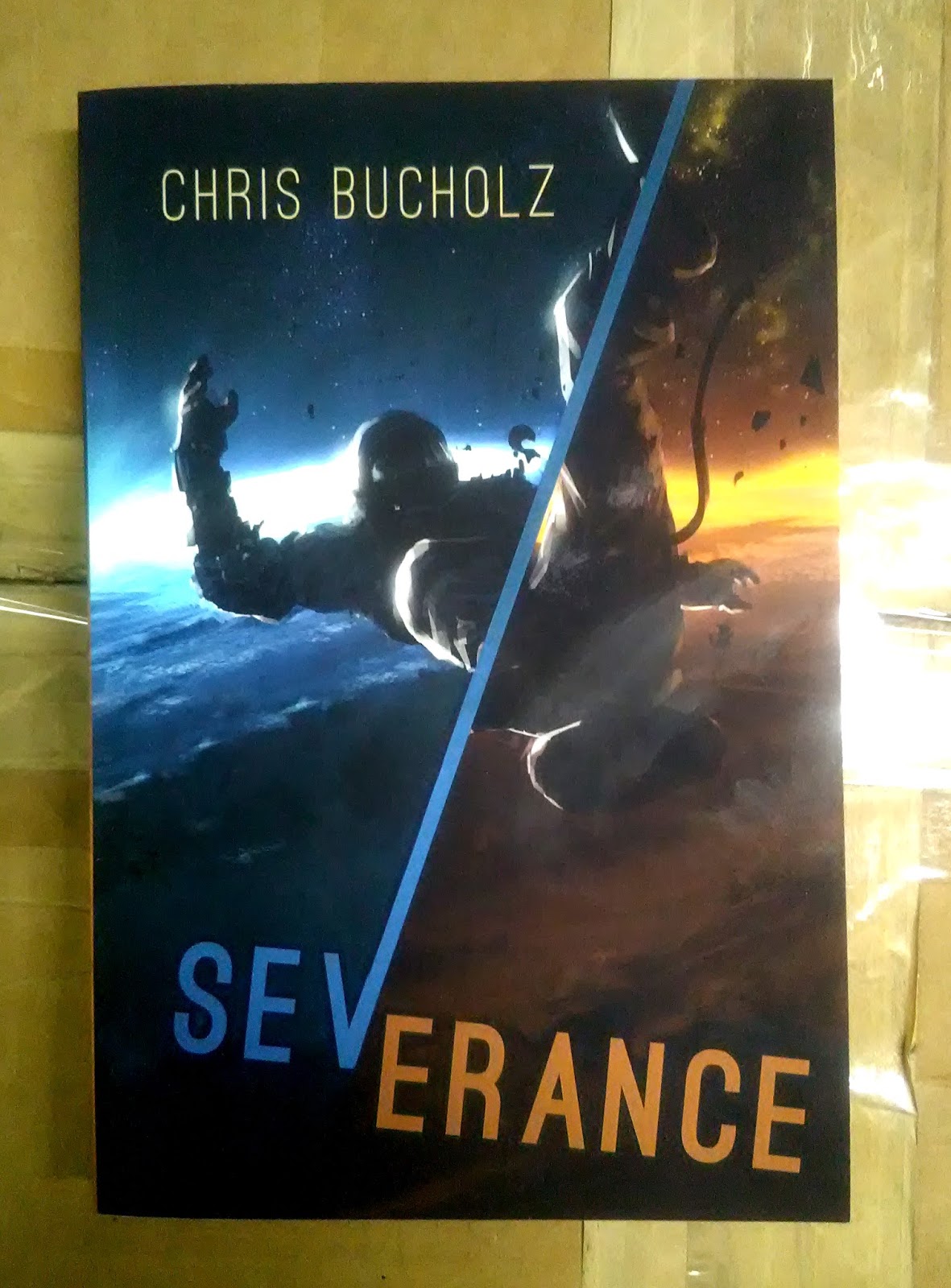
If you like funny books but have trouble finding funny novels I can't recommend Cracked.com enough. Aside from the fact that it's a hilarious humor site it's also a fantastic place to find authors because the Cracked writers are constantly getting book deals.
Chris Bucholz writes bad advice columns and funny articles for Cracked, he's also written a novel called Severance about a generation ship from Earth traveling to an Earth-like planet a couple of hundred years in the future. The novel is a combination of science fiction, murder mystery, comedy, and action/adventure. It's sort of an inverted Sherlock Holmes thing, actually, with minor criminals solving a major crime that could change the future of the human race as a whole.
The story jumps to different points in the process of moving from Earth to a new planet which gives a really interesting perspective on the history set up by the story. There is also a great background discussion of the issues of genetic diversity that would become a problem on any realistic colonizing journey, which is handled very well and brings up the ethics of gene tampering and that's exactly the kind of geeky theoretical ethical dilemma I'm here for.
I really liked the characters and history of the ship, I think a lot of work went into building a believable world. I enjoyed the novel as a whole but it was little details like meat-trees and faulty thermometers that helped create an element of realism for such a speculative setting.
I'd love to see more novels from Bucholz in the future, and I'd definitely be open to reading more of his work.
Cheers,
- Alli
Bucholz, Chris. Severance. Apex Publications. Lexington: Kentucky. 2014.
Sunday, September 4, 2016
Problems and the bigger ones

There are plenty of books that fuck me up but Kindred fucked me up pretty good. It was painful to read but felt cleansing. Cathartic is the best word for it.
It also made me realize that the best books I've read this year have all been written by black women, a subset of authors who were largely missing from the readings assigned from kindergarten all the way up until I got my BA in English literature.
But Octavia Butler did show up in ONE of my college English Classes. We read a short story of hers in my junior college science fiction survey class. I'm really glad I got the opportunity to read her, but FUCK, why did no one think she belonged in my Modern American Lit survey?
Kindred is amazing and painful. It pulls back the veil on the ugliness of slavery from a 20th century perspective while ALSO illustrating that the 20th century was by no-means a post-racial society. Dana is a brilliantly crafted character who has to struggle with layers and layers of oppression and interpretation of that oppression both in her time and in the antebellum era she is transported to.
There's a lot that I could talk about here; Dana's painful encounters with Rufus, her guilt over her interactions with Sarah, her inability to find her place in either time, but I think one of the most interesting and fraught relationships shown in the novel is Dana's marriage to Kevin. She loves Kevin and he loves her but there's a distance between them that Kevin alone is incapable of seeing. The subtlety of Butler's commentary on 20th century race relations through Kevin's privileged perspective of racism is beautifully done and a tremendous part of what makes the novel so compelling - even when Dana is safe she's never really safe, even when she is recognized as a person she is still a woman, and black, and still seen as somehow "less than."
I'd strongly recommend that anyone reading this blog read Kindred. It's stunning.
Cheers,
- Alli
Butler, Octavia. Kindred. Beacon Press. Boston: Massachusetts. 2003. (1979).
Wednesday, August 31, 2016
Burning with anxiety

Hey, you wanna get weird and esoteric and nitpicky with me for a sec? Of course you do; if you didn't want to do that sort of thing you wouldn't be reading a book blog written by a pedantic jerk with a frighteningly good memory.
This, by the way, has basically nothing to do with the book I'm talking about. It's just weird and esoteric and nitpicky.
So. Anyway. How odd is it for you, as a reader, to come across a self-referential thing in the work of an author you're reading for the first time? Like part of me says it would be kind of cool - you read this late book that makes reference to an early book but then later you read the early book and go "OH MY FUCKING GOD, THAT'S WHAT THEY WERE TALKING ABOUT" and your mind is blown. But the larger part of me thinks that it would stand out as something that could have been edited out? Like if you didn't know that one or two throwaway lines were referencing another book by the same author, one that had no other connection to the book you're currently reading and in context sounds weird when juxtaposed with the work you're holding in your hand, would it just confuse you as to why an editor allowed that to go to print?
I bring this up because Joe Hill makes one throwaway reference to NOS4A2 in The Fireman and it made me kind of smirk, because I'd read the book and I got the reference, but it wasn't a particularly graceful reference and also made me cringe a tiny bit because it felt forced.
But maybe that's just me. When you're reading you're supposed to feel empathy toward the characters you're reading about but I have such a surplus of empathy that I step out of the story to try to parse the emotional state of hypothetical other readers.
Yes, I do have social anxiety. How did you know?
Anyway the book is great! I really enjoyed reading it and got so into the story that at one point I had to put the book down and wander away for two days because the fallout that I could feel coming was upsetting me. Which is fantastic when you're reading a thriller. It legitimately got me so invested in the story and the action that I couldn't handle the tension and maybe only made myself more anxious by putting off a sense of resolution for two days.
Also, fun sidenote, the other Joe Hill novels I've read have an issue with rape. As in there's a bit too much of it and it's a bit graphic in a way that seems gratuitous or it makes a too-huge impact on the story (N0S4A2 did not have this issue). This book did not have that problem! There's implied rape/harassment but it's character background for an antagonist instead of character definition for a protagonist. I really appreciated that! It's clear that Hill does not like rape, and doesn't want his readers to think rape is a good thing, but that has led to an unfortunate tendency toward rape-as-backstory OR believed-rape-as-backstory. Again, this doesn't have that! Our protagonist is not a rape survivor; she's had her share of shit to deal with but that is not among her pile of shit.
Also it's pretty goddamned cool to have an apocalyptic novel with (Spoilers! Spoilers!) a pregnant woman, a d/Deaf child, a teenage girl defying gender norms, and a middle-aged black woman as the primary protagonists. I like that a lot, I hope a lot of people like that a lot, and I hope that more white authors will begin putting marginalized characters in their works without being afraid that it'll kick them out of the running for the bestseller list.
Anyway. In general I say fuck yes, this was a tremendously fun book to read. I thought Hill did a great job of handling everything from paranoid reactions to potential threats (Jacob) to cult-like reactions among the infected (Carol) to survivor's guilt (John). The Fireman is a compelling page-turner that I will be reading again at a later date, and I'm sure I'll enjoy it similarly on the second go-round.
Cheers,
- Alli
Hill, Joe. The Fireman. Harper Collins. New York: New York. 2016.
Wednesday, August 17, 2016
Peace at last
I got so worn out reading War and Peace that it took me a couple of days to recover. Part of me had trouble leaving my Kindle behind when I left the house because I was sure I could pound out another 1-2% while in line at the grocery store or while waiting for my laundry to finish. But I was done! There was no more book to read! I could have the weekend to myself and move on. It was time to start another book. But I didn't. I couldn't.
I don't know that I've ever been so exhausted by a book. War and Peace was more tiring than Worm, though about half a million words shorter.
I think a lot of that had to do with the fact that I kept wanting to fling the book against the wall. I was so tired of all the court rules and who could and couldn't marry one another, and people making just the most ridiculous self-sacrifices for reasons that must be fundamentally Russian because they sure as hell didn't translate to my experience. But neither did Corsican-Frenchmen. Napoleon was intensely frustrating to read, which I think was the point. I mean really almost the entire book was beautifully crafted and family relationships were moving and just so full of minute details that it hits you in the face like a cannonball.
Also every single word about the Masons seemed like an utter waste of space. I mean I get that it was probably supposed to be a very important illustration of Pierre's wavering nature that would prove to be such a striking contrast to his character after the burning of Moscow, but for fuck's sake I can't bring myself to care about Masons NOW, when they're supposed to be actually controlling the world, how could I work up the shits to give about an organization that was ineffectually laying the groundwork to eventually fail at taking over the world? I couldn't. Fuck the masons. And fuck fraternal orgs in general - let some ladies in on the action.
Was I the only one who was supremely creeped out by the benevolent misogyny of the final chapter, by the way? Probably not, not in the least because it was so jarring. The bizarre shift in Natasha's character threw me for a loop, and Natasha and Mary's conforming to their husbands was unexpected and utterly overwhelming.
I mean I guess I shouldn't be surprised that a book about an era obsessed with class would also be obsessed with making sure people fit into their roles, but I reserve my right to look askance at a novel that tacks happily-ever-after relationships onto the lives of two women who have been interesting and defiant and different every time we've seen them.
I'm glad it's done. I wouldn't say I'm done with Tolstoy, I liked how he crafted characters and his luxuriant wallowing in the scenes he set, but I need a hell of a break.
Cheers,
- Alli
Tolstoy, Leo. War and Peace. Gutenberg.Org. 1869. http://www.gutenberg.org/ebooks/2600
Subscribe to:
Posts (Atom)