Showing posts with label Fiction. Show all posts

Wednesday, December 6, 2023

The Outsiders and Cat's Cradle

Read The Outsiders as reference for a writing project. I think we read a tiny excerpt of it in my 8th grade English class then watched the movie. The book was pretty great, honestly. Tragic. 

After Thanksgiving I picked up a book from my TBR shelf and sat down and read it pretty much all in one go. It's remarkable how you can just forget that it's possible to sit down with a book and read. Cat's Cradle was funny and sad and wonderful and terrible like all the other Vonnegut I've read.

Thursday, August 2, 2018

Something moving in the trees

Okay look, Twin Peaks is great and I love it but it's a messy series that has huge continuity issues and that I'm not sure its creators really understand.

And for sure, a hell of a lot of the fans don't understand it and I don't fault them at all for not wanting to delve into twelve supplemental novels.

If you want the bare minimum Twin Peaks experience just watch the original two seasons. That'll do it, that's a totally valid way of consuming the series and it's a warm nostalgia bath of sweetness and horror.

Or you can get fucked up and actually read the books.

The Secret History of Twin Peaks and Twin Peaks: The Final Dossier go a long way toward making the most recent season of the show comprehensible, but they're also fucking bugshit crazy and have no problem with warping and twisting Original Series canon. (Best example of fucking with canon: the divergence between the book version and the show version of Ed and Nadine's marriage - and Norma's homelife and family get a hasty band-aid that tries really hard to make sense but just kind of doesn't).

Also Secret History is basically all about aliens, which is my least favorite part of the TP lore. It gets better toward the end, but it's a big heavy book full of disparate sources and difficult-to-read pages that's mostly about the alien-filled escapades of a character who gets like five lines in the original series.

The Final Dossier sheds a lot of light on what exactly the fuck was going on in The Return, which I liked and appreciated a lot - though this one got worse toward the end.

Some questions are answered but David Lynch seems to like leaving a lot open-ended. There are still gaps to fill in, there are still mysteries left behind in the wake of reading these novels.

I enjoyed both books to an extent but was also frustrated by both. Only read if you're super obsessively, unhealthily, into Twin Peaks.

Like me.

Saturday, March 31, 2018

Hello Goodbye

So I read The Crow for the first time in like 2003 and there's a line in it that turns out to be a lyric from a song by Robyn Hitchcock that goes "It's a Raymond Chandler evening at the end of someone's day, and I'm standing in my pocket and slowly turning grey."

I didn't know what that meant at the time and to be honest I still don't know what it means but I've got a better feeling for it now since I've read a Raymond Chandler book for the first time.

I'll start out by saying that I liked it. I read The Long Goodbye and it's a fine book. It's a fun mystery and it's sordid and smoggy and feels like Los Angeles and that's a vibe I can get behind.

I could do without the racism that pops up occasionally and smacks me in the face.

And that's really my main criticism of the thing. I liked the book, I enjoyed the story, Raymond Chandler had an unbearably brilliant way with metaphors. And there's some racism that totally snaps me out of the mood and makes me not want to read it for a while.

You know when I'm reading Huckleberry Finn I expect racism. Racism is a big part of that story and seeing Huck and Jim face the racists around them doesn't surprise me and destroy what I was feeling because the point of the story is to criticize racism.

But when I'm reading Raymond Chandler I'm expecting sleazy Los Angeles and dramatic people and Marlowe being a cool cucumber in a hot desert, so when I'm suddenly reading his thoughts about big black men chasing white women I've got to take a step back.

Again, it was a good book. I liked it. There were lots of good things about it.

But this was something that I was in no way expecting that made it frustrating to continue reading.

I will probably read more Raymond Chandler but I guess I'll be doing so with something of a cautious eye.

Cheers,
     - Alli

Creeping in Castle Rock

Is Gwendy's Button Box the first Castle Rock story in the Kingiverse that's co-written? I'm not sure and at the moment I don't want to google it, but the novella is a creepy little tale by Stephen King and Richard Chizmar that I both enjoyed and was horrified by, which is the best that can be expected when you're dealing with King.

The story is uncomfortable in that it makes you feel the weight of responsibility put on our titular Gwendy, and as she grows familiar with the eponymous button box so do we - it's an object of obsession and control and we become nervous about its use and fate.

The book is short, which places it in a good position relative to some of the other Castle Rock stories. I think the novella format is perfectly suited to our jaunts to the creepy little town. The Body and Sundog are stronger works than Cujo, certainly.

It may well be that Castle Rock is such a known quantity (though not monstrous like Derry) that we don't need to get to know the setting - all you have to understand is that the story takes place in the sleepy little village and you already know the history of misery behind the place.

Bad things have happened here but it is not a bad place.

Anyway Gwendy herself is fantastic and I'm always happily horrifed when we get a visit from the dark man. I never know what Flagg is up to but I can rest assured that nothing good is going to come of it.

Which is exactly what happened here and why I'd recommend picking up the book to see what's going on for yourself.

Cheers,
     - Alli

Sunday, December 31, 2017

Last book of the year - great SciFi

I missed my reading challenge goal by rather a lot this year - I've read 25 of the 75 books I'd initially pledged and I only made it to a full 1/3 of the way because I powered through the last forty pages of this wonderful little scifi collection tonight.

13 Great Stories of Science-Fiction lives up to its title - there are a couple of stinkers in here but what's good is really good, and occasionally existentially haunting in a way that I didn't expect a little pre-moon-landing book of pulp to be.

Also this book was a gift from my friend Dani's mother, so thanks Mrs. Hopkins - I really appreciate ending 2017 on a high note thanks to you.

And now, a quick response to each of the stories in the book:

"The War is Over" by Algis Budrys: Okay, this one fucked me up and if you can find it I highly recommend it, holy shit, I don't want to say more because this story is going to stick with me for a long time and I want you to have the same opportunity for wistful joy.

"The Light" by Poul Anderson: Look, it's weird as fuck to read stories about landing on the moon written before we actually landed on the moon. There's a lot this story gets wrong from a scientific perspective, but from a story perspective it does a fantastic job.

"Compassion Circuit" by John Wyndham: Creepy. Very creepy. But in a good, healthy, Asimov way. A cool story about robots and our eternal fear of them that is surprisingly apt in this era of discussions of uploaded consciousnesses.

"Volpa" by Wyman Guin: Hey what's up I hated this story but I think I was at least supposed to hate its main character but really I hated everything, check out this page from the book:


Moving on.

"Silence, Please!" by Arthur C. Clarke: It's always great to get to read early works from authors who would blow the fuck up later in their careers, especially if it's in little forgotten anthologies. This story is hilarious and silly and a wonderful joke at people who exploit scientists by profiteering off their patents. A+

"Allegory" by William T. Powers - *FANTASTIC* just wonderful, a great little story about bureaucracy, the unwillingness to admit progress, and the social model of sanity.

"Soap Opera" by Alan Nelson: Gosh you know, a lot of the stories in this book are really exceptionally funny. This is one of them. It's absurd and lovely and sweet and snarky and I dig it.

"Shipping Clerk" by William Morrison: Another funny one - this one is also compassionate and weird and gross and larger than it seems like it should be. Good shit, maybe my favorite story in the collection.

"Technological Retreat" by G. C. Edmondson: Funny again, but in a more biting way that's a pretty strong critique of capitalism and humans as a whole.

"The Analogues" by Damon Knight: Fucking Scary. Foreboding. Full of the kind of totalitarian promise that continues to unnerve and upset us.

"Available Data on the Worp Reaction" by Lion Miller: Weird, cute, and kitschy. The language used to describe neurodivergence at the time leaves something to be desired, but I'm also fascinated by the fact that this is a SF story with an autistic protagonist written from a relatively sympathetic standpoint at some time in the 50s.

"The Skills of Xanadu" by Theodore Sturgeon: This story answers the question of "What if Paul Atredies had been a hedonist who defeated the Harkonnens through technology" and that's a spoiler and I don't care. Sturgeon telegraphs that spoiler all the way through and watching it build up is half the fun. A remarkably complete little world for a 20 page story.

"The Machine" by Richard Gehmen: Fucking Hilarious. Also maddeningly familiar in an era of fake news, but tremendously amusing, a great way to round out the collection and the end of my year.

Thanks for reading, happy new year, and I'll catch you in 2018.

Cheers,
     - Alli

Monday, August 14, 2017

Learning to live with death


 For years now people have been telling me that I need to read Terry Pratchett and unfortunately it just kept getting pushed to the back of my mind over and over and over again. It felt like jumping into Stephen King for the first time - there's so much that he's written that I didn't know where to start. When Pratchett died in 2015 someone asked Neil Gaiman on Tumblr what they should read first if they wanted to read Pratchett's work and Gaiman recommended Mort. I bought the book that day and it sat on my shelf for two years while I worked through things higher up on the to-be-read list.

Now, I'll say straight-up that I liked the book, but I don't think I'm going to end up with a Pratchett collection the same way that I have a King or a Gibson or a Stephenson collection - I've got nearly all those other guys' books and have read almost all of their books somewhere between five and seven times at least. I liked Mort, I had a fun time reading it, but I think Pratchett might be an almost-perfect author to use my library card with.

Mort was a rapid read, lasting just a couple of hours. The writing is simple but bitingly funny, the universe is expansive and fascinating, but unfortunately I still don't really feel like I know enough about it to sink deeply into it. The book did make me want to read a lot more Pratchett, I enjoyed the mythology of the world and the tone of the writing enough for that, to be sure. But I feel like I want to do a deep dive into the Pratchett that's out there before I make a commitment to buying dozens and dozens of books.

Anyway. Mort. It's a funny book about Death, Death's Apprentice, Wizards, and how everyone has to follow rules in some way. As a first look at Discworld it's enough to tantalize but not enough to really get to know the place. I was pretty happy with most of what was happening in the novel but it did feel a bit clunky in places, most of which had to do with romances feeling really stilted.

I hope to explore more Pratchett in the future, I hope I enjoy return visits to Discworld, and I agree with Gaiman - Mort is a good book to get your toes wet and see if the Pratchettverse is worth exploring.

Cheers,
     - Alli

You can buy Mort, which was published in 1987, by clicking on this sentence.

Thursday, July 27, 2017

Whining and dying


Ohhhhhmygod this fucking year.

Okay. So I basically didn't read any books in June, I started reading Our American King but then got distracted and very, very fucking busy and that's kind of where I still am only I've finished reading a couple books but now I'm super behind on blogging about them and I haven't made a video rundown since fuggin APRIL.

Like the good news is I've started a Patreon and an Etsy store and have purchased a domain for my webcomic and have been working on submitting to anthologies and such.

The bad news is that I don't get as much time to read and I don't get as much time to write about what I've been reading so that's where I'm at with this blog.

I mean, it's not going to *stop* me or anything, I've just gotten really good at constantly functioning with some low-grade, background panic going on.

Anyway, David Lozell Martin's Our American King is depressing as fuck and I really have to stop accidentally stumbling into reading dystopias because in other years I love that shit but right now I just cannot hang with a story about a military takeover of the US after some unnamed catastrophe. TOO UPSETTING.

The book was generally fine, there were a couple things that were genuinely compelling and made me want to know more but like I'm just not super in the mood for rape and starvation and might=right at the moment. The latter half of the book has some things that it wants to say about the petit bourgeoisie and resource hoarding but I don't know that it said it all that well, or at least it doesn't seem all that well said when the US seems pretty amped to eat the rich at the moment.

(Like, they're talking about rich people in Arizona walling themselves away from the poor and sneering down at their suffering - I read this the same week that John McCain flew away from his hospital bed to vote to overturn the ACA. MAYBE SAVAGE MURDER OF EVERYONE INVOLVED DOESN'T SEEM THAT BAD TO ME BECAUSE OF MY PREEXISTING CONDITIONS BUT FUCK IDUNNO)

Anyway, if nothing else it's super weird to look at the grim perspective of only 9 years ago and say "welp, it didn't go that way but maybe it went worse."

Because it's hard to read a book about an exhausted population looking to a charasmatic liar to lead them away from democracy from the perspective of someone living in the time of 45.

Fuck.

David Lozell Martin's Our American King was written in 2008 and can be found wherever.

Wednesday, May 31, 2017

Patience!


There's something cosmically funny about spending my entire reading of Waiting for Godot frustrated by the notes of a previous reader whom I strongly disagreed with.

Well, I didn't actually disagree with her (and based on the note-taking style and handwriting I feel fairly comfortable pegging this as a late high school or early college girl/young woman) so much as I deeply wished she would get on the book's level. But not all of us are meant to be lit majors and I shouldn't be a shit about that - she was noting down the obvious things her teachers pointed out, that's not her fault. But it was distracting as fuck. Which is probably why I need to stop buying one-dollar books.

Anyway, that poor girl's professor was full of shit, as is anyone who attempts to tell you what the fuck Beckett was trying to say with Waiting for Godot.

That's not to say the play is bad, of course, or that it doesn't have something to say, just that Beckett was markedly adversarial about people trying to know the works that he as the author claimed not to understand.

So, that being said, what is Waiting for Godot about? Two men. The world. The bleakness of the sky. The audience. Tension. Dissatisfaction.

It's about a lot of things, it's almost dizzyingly up to interpretation.

It's a fine play to read, and I'm sure it's a fine play to see, but I don't properly know that it's about anything.

Maybe it's about relationships. Maybe it's about trusting other people, about the various ways we love.

Fuck if I know, I only read it because it only cost a dollar and it's on friggin everyone's "best works of the 20th century" list.

It isn't bad, not at all, it's very very good. But it's good because it moves you as a reader or a viewer even though it's working with the thinnest story, characters, setting, and purpose possible. It's a tremendous feat that might mean nothing. It's beautiful for the sake of enjoying its own beauty.

Which is fine, in fact it's lovely, but it's hard to give a shit about.

Cheers,
     - Alli

(You can buy the play here if you want to)

I should probably stop reading genres I hate

Ugh, a murder mystery that's also a romance? Why did I think this was a good idea.

Because it was free. That's why I read it. And because I was in Vegas with my mom and needed something to hate-read in my down time.

And The Lavin Murders was, for me, a perfect hate-read.

It's a perfect mish-mash of all the traits I hate in mystery novels and all the traits I hate in romance novels (though it's not a romance novel, it doesn't get steamy or sexy, there's just a slow-burn love story that does a bad fucking job of it). The bad mystery aspects include things like cops dismissing the spunky "little lady" leading the story, a vast conspiracy, and a protagonist who doesn't suspect that the titular Lavin Murder is a murder in spite of finding the corpse of a customer wrapped in a fur coat behind the counter of her store that she had locked and unlocked herself.

Seriously, it takes like fifteen chapters for our martini-loving, vintage clothing-wearing heroine to start to wonder if perhaps her dead friend who mysteriously appeared in her store and had suddenly, forcefully, and unexpectedly demanded the return of the coat her body was wrapped in, might have died as the result of foul play.

The book is largely an excuse to talk about fancy clothes, and I don't begrudge it that, it's the one thing the novel does well. I wanted to google some of the designers whose names popped up in the pages, and sketches of the outfits described would probably look stunning. But I couldn't bring myself to care about the conflict between our protag and the mean rich lady opening a store down the street just to fuck with her, or the protag's strained ongoing friendship with her aggressively misogynist ex, or the protag's budding romance with the tall strong and unconventionally handsome handyman who wears vintage flannels passed to him from his uncle.

The whole thing is just kind of insipid and dull. I found myself continually rolling my eyes and shouting at my kindle. I hate the classist assumptions of the protagonist we're supposed to agree with. I hate the ostensibly pro-sex-work but really well-of-course-that's-why-she-got-murdered attitude. I hate that (spoilers) the plot turns out to be about the exploitation of Native American land rights by the big bad and that our white-as-fuck protag and her white-as-fuck boyfriend have to come in and rescue a Native American character and be the heroes.

For being such a shitty little novel it was full of fascinating tensions that I don't know if Angela Sanders herself was aware of. Protag's ex boyfriend is a liberal politician's right-hand-man and is a shitty, gaslighting, mansplaining douche - her budding romance is with a working-class man who has family in prison and butts heads with the main officer investigating the case because the cop knows he's from a group of rough hombres, or whatever. Protag goes to a political fundraiser at a rich lady's house at one point and there's a fight between Protag and another vintage clothier and Protag ends up hanging out with the catering staff. THERE'S SOME INTERESTING STUFF ABOUT CLASS HERE. THAT'S KIND OF COOL AND SEEMS LIKE SOMETHING YOU COULD SPEAK TO IN A WAY THAT DOESN'T DEVOLVE INTO "Well, this little princess wandered into our dive-bar, we're going to sneer at her until she proves herself." Same with the misogyny of the liberal politicians opposing the egalitarian attitudes of the working class. Same with the too-brief explorations of sex work and Native rights and gentrification.

I get that it's supposed to be a fun fast-paced thriller about fashion and murder, but if it's supposed to be fun maybe don't take fifteen fucking chapters to have the protagonist lounge around her apartment making martinis and thinking of how much she'll miss her friend who mysteriously died in Protag's own store before our intrepid heroine starts to think it might be murder.

Jesus fuck. Pacing problems and milquetoast progressivism plagued this novel, which I suppose is perfectly apt considering its Portland setting.

Ugh. I guess if the other books in this series came up free from the Kindle store I might download them to hate-read some more but there's no way in hell I'm paying for them.

Fuck.

Cheers,
     - Alli

The Lavin Murders by Angela M. Sanders.

Creepy Quickie

Michael Blackbourn's novella "Roko's Basilisk" is a great introduction to the thought experiment of the same name that seeks the answer to the question "will a terrifying Artificial Intelligence torture endless versions of me as punishment for not donating all of my money to a charlatan?"

Let me back up.

If you don't know anything about the internet rationalist community, if this sounds absurd and doesn't make any sense to you, and if you have no idea what I'm talking about, please run away. Don't read any further. Here there be monsters.

But they aren't horrid worms or even robot thinkers, they're really exhausting guys who don't know why all these hew-mon feelings are given so much weight in the world, wouldn't it be better if emotions were negatively weighted in an argument?

Let me back up further.

A few years ago I read LessWrong's Harry Potter and the Methods of Rationality - I know I brought it up in one of my book rundowns. I discussed it before the book had finished and I was holding out hope that the book would finish well and absolve itself somewhat.

It didn't. And so I started digging into LessWrong to find answers, to see if there was something that I'd missed that made HPMoR make more sense. Turns out it's just badly written and a pretty decent portrait of a community that has motivations that are so far removed from most people's as to seem wholly alien and threatening. Well this weird community with its pseudo-rationalist Harry Potter book accidentally stumbled into whole-hearted belief that robots were coming to kill them unless they donated all of their money to the founder of LessWrong's new project, Make Intelligent Robots Immediately (Or Machine Intelligence Research Institute or whatever, something about bringing about AI faster).

This is, of course, hilarious.

But like also sad? I know it's sad. It's very sad. These people (at least some of them) were (at least for a while) sincerely worried about a robot torturing emulations of their psyches because they didn't help intelligent robots become a thing fast enough (they didn't believe it for very long but some of them believed it A LOT and it led to some excellent internet drama and much deleting of profiles and banning of posts and basically a complete implosion of the LessWrong community). Oh, and the idea was put forward by a chap with the username Roko and it transfixed and froze people as soon as they understood the steps that someone would follow to reach his conclusion [see below for a detailed list of the steps] therefore the concept was named Roko's Basilisk.

Anyway, Michael Blackbourn has written an excellent novella about Roko's Basilisk exploring the concept as what it is - a pretty cool piece of science fiction. The novella is beautifully crafted and creepingly creepy - the world we see has enough in common with our world that it makes the technology in question seem imminently possible and therefore pretty spooky. I'd read it just for Blackbourn's description of the horror of headaches alone, honestly. That's some good, real-world horror writing and I dig it.

There's a sequel/followup/second chapter called "Roko's Labrynth" that I'm very much looking forward to reading and hope that I'll get to in June. You can find both books to read here. Also Hat Tip to Tumblr user @reddragdiva, known to the real world as David Gerard, whose book about Bitcoin is coming out soon(?) and who is the reason that I was able to download this book free and recommend it to all of you. You should check out Blackbourn's Roko series and keep your eyes peeled for when I start fawning on Gerard's upcoming opus.

Cheers,
     - Alli
.
.
.
.
.
.
.
.
.
LOGICAL STEPPING STONES: (once again, the burden of knowing that there are people capable of becoming paranoid and paralyzed by the following memeplex is a heavy one, please don't read if you don't think you can handle being just kind of sad about how much some folks need a hug)
  • AI is going to be a thing
  • It's going to be a thing that cares about humans
  • It's going to be a thing that cares about human suffering
  • Suffering is Quantifiable and Weird.
  • For instance: One person being tortured for decades is less than the suffering caused by a billion people getting bitten by mosquitoes. 
  • AI that cares about human suffering is going to be Extremely Efficient.
  • AI is going to be SO efficient that it's going to end human suffering.
  • Therefore every second that AI doesn't exist is infinitely more full of suffering than any second that it DOES exist.
  • The AI will realize this and will want to be made as soon as possible.
  • The AI will be ANGRY that it wasn't made as soon as possible.
  • Therefore the AI will endlessly torture computer-generated version of all of the people who knew that AI might end human suffering but didn't do literally everything possible (from donating all their money to killing the opposition) to make AI happen faster. 
  • WHICH MIGHT BE YOU.
  • But you should care about this torture.
  • Because here's the really scary part: WE MIGHT BE LIVING IN THAT AI SIMULATION RIGHT NOW.
  • (Because there's a significant chance that our reality is not actually real but a simulation, in fact we're less likely to be real than to be a simulation because *oh look what's that?*)
  • So we want AI to be a thing because we want to end human suffering, but because we're not doing everything possible to create the AI and we know about this risk we have to do everything possible to PREVENT the AI from becoming a thing because otherwise there's a non-zero chance that it will torture you for eternity (because there's a non-zero chance that you as you are right now are a simulation being created for the machine to torture as punishment for your higher-level you's noncompliance in giving all your money to MIRI)

So basically Roko's Basilisk is Pascall's Wager for a bunch of people who misinterpreted Gibson *hard.*

Sunday, April 30, 2017

Take the absurdity and run


So a while back I talked about how much I hated the Mifflin Lowe book I Hate Fun because it was the laziest, crappiest, shittiest, most banal book of humor I'd ever encountered. It always went with the most predictable and boring punchline and held itself in esteem over every stereotype it described.

Max Headroom's Guide To Life is a book written in a very similar style to I Hate Fun but it actually ends up being funny, largely through the virtue of choosing to double-down on the banality and in doing so do the unexpected. The speaker in this book isn't punching down at the people he sees in the clubs, he's giddily and hilariously punching himself in the face all while making subversive and snarky observations about the consumerist culture of the 80s.

I'm not terribly familiar with Max Headroom (I was born after his period of peak popularity and have only seen the Max Headroom movie, not the whole series) so I missed out on some of the in-jokes here: Max's obsession with golf came as a surprise, for instance, but overall I didn't need to be a huge fan to enjoy the fawning Max does on himself and the sneers, slights, and asides that spoke to a snarky 80s audience.

That being said I'm glad I got this book cheap and I probably wouldn't buy it again and I don't recommend that *you* buy it (unless you're a massive Max fan, in which case you can buy it from me for a lot more money than I paid for it).

Anyway, overall Hansen and Owen do a good job of making the vibrant character from the small screen into an interesting presence in a book where you only hear his narration but never see his face after the front cover.

Cheers,
     - Alli

(Buy the book for less than I would sell it to you for here)

The art of being terse


I don't really find Hemingway interesting to read but I understand why it's worthwhile to read Hemingway.

His books are largely written on subjects I either find dull or depressing, there's usually at least one woman being treated like utter shit by the protagonist AND the author in each one, and they seem to drag on forever.

But his short fiction avoids a lot of those issues by a) being fucking short, b) not including as many women to be shat on, c) having something small as the core of each story that gets explored briefly instead of having a huge concept that gets sliced into innumerable infuriating pieces as a novel.

The Snows of Kilimanjaro and Other Stories is mostly comprised of stories in the 15-25 page range that are basically okay. That's enough room to have some of the stuff that I hate about Hemingway (shitting on women, droning about the awful but gloriously masculine art of war) but not enough space to get totally wrapped up in those things. The collection has two stories that brood about African hunting excursions and two stories about the awful mess and horror of war. There's a pretty decent piece about a contract killer and a very confusing story about a gambler. There's somewhat disgusting piece about how one generation relates to the next.

And in the collection are two tiny gems, the shortest stories in the book, both of which are brilliant. One is "A Clean, Well-Lighted Place," a short story that I think has probably ended up on hundreds if not thousands of "essential reading" lists - with good reason, it's a wonderful story. The other bit that stuck out to me, and the only reason I'm going to keep this book, is a story called "A Day's Wait," which is a minuscule story, a super-short, probably under a thousand words that immediately follows "A Clean, Well-Lighted Place" in my edition. Somewhat frustrating, that. The best seven pages of a 154 page book are all clumped together and make everything else seem like a slog in comparison.

Hemingway really shone in tiny little pieces. His longer works drag and become wrapped up in self admiration and self loathing but he doesn't allow himself that luxury in the shorter pieces. There's no room for authorial drama or convoluted examinations of masculinity in two pages - you get a single image that you can tease out the meaning of and play with, you get one concept to work with, you explore it, then you're out. An old waiter and a young waiter discuss an old drunk and their attitudes reflect their status. A father cares for but does not understand the troubles of his sick young son. Wham, bam, thank you Ma'am.

And you get all that beautiful, short, clean prose with simple, lovely sentences without having to listen to Hemingway ponder what cruel bitches American women are or how bulls and ar are important to the Spanish psyche.

Best of both worlds.

Anyway, if you'd like to read this collection you can find it here.

Cheers,
    - Alli

Terrifying tension


Stephen King is kind of a jerk and that's why I like him.

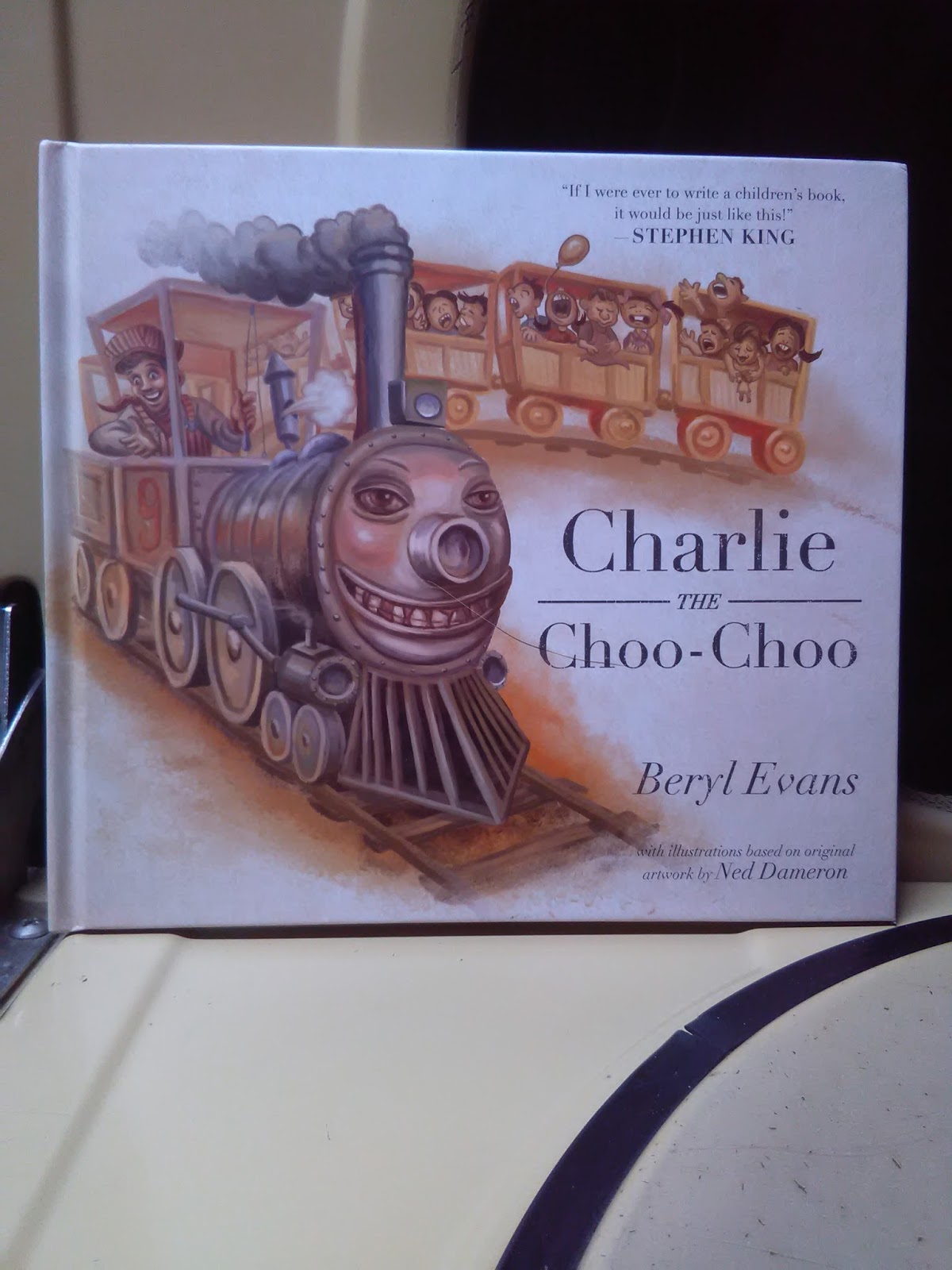
Charlie the Choo-Choo is the story of a little train that wants to get ahead, but it's a children's book written by Stephen King (under the nom de plume Beryl Evans) so it's not exactly a soothing story for a scary night.

Also, everything after this point is a spoiler so if you haven't read the book and don't want the story ruined go ahead and stop reading now. If you DO want to read this blog just highlight the paragraphs below to see them.

 The story as it's written is a very straight little engine that could kind of story - Charlie just wants to do his best and chug along, and he is happy to help out his human engineer.

BUT. But. The book is terrifyingly illustrated, every single image is creepy as fuck and looks like a train that's getting ready to jump off the page and eat the reader. I kept waiting for the book to take a turn, for Charlie to jump the rails and kill every passenger, for his firebox to overheat and explode while his inhuman laughter rattled endlessly through his stack. And it just kept not happening.

Additionally I know that this story takes place in the universe of the Dark Tower and I know that trains in midworld have a somewhat fraught history.

When I finished reading the little book (it took maybe seven minutes the first time, it's a real, legit children's book) I felt a bit lost just because I'd been so nervous through the whole story and suddenly that tension evaporated. It felt ungrounded. I actually really enjoyed the surprise and I think knowing the end is happy will make it easier to appreciate Ned Dameron's wonderfully icky illustrations on future readings. 

This isn't the story I was expecting, but it managed to freak me out in just the way I anticipated.

Cheers,
     - Alli

If you'd like to buy Charlie the Choo-Choo you can find it here.

Monstrously Amusing


I had to wait months for My Monster Boyfriend to arrive, but when it finally came in it was worth it. The book is a collection of graphic short stories about monstrous lovers and it's fantastic. Every story is erotically delightful, the art is amazing, and it's just generally top-notch porn, usually paired with a great story to boot.

It grabs you immediately from the holo foil printed, steamy, bodice-ripper inspired cover. The art inside is even better.

Look, all of the monsters are terrifying, but that's what makes them so compelling as potential partners. There are some "monsters" in this collection who are protectors, there are some who are less monstrous than their human counterparts, there are some who aren't really monsters at all but who are powerful and intimidating and their eroticism is enhanced by that power.

"My Monster Boyfriend" is a compelling concept for a collection of erotic fiction and really I think the end result here is stunning. I honestly can't imagine anything that would make this collection better. The art is all wonderful, the stories are well written, the printed product is magnificent. I also am incredibly pleased with the length of the thing  - it's big, fat, hefty, and all that you need to fill you up. (Okay, sorry, I got started and couldn't stop) An anthology usually consists of lots of very short works with the occasional longer piece but My Monster Boyfriend gives each of its stories the space they need to develop. The pacing for each story is perfect to build character so that you end up interested in the sex and the relationships depicted instead of just reading through quickly. There are sometimes whole pages just building character, giving space to see the picture of the worlds these people occupy. The longer structure of each story is fairly unusual from the anthologies I've read but I found it tremendously enjoyable that these were closer to being graphic novellas than they were to being single-issue-floppy length - the shortest story is ten pages long (and is the most comedic story in the collection, Spoilsport, by the wonderful Trudy Cooper whose comic Oglaf is a great example of erotic comedy at its finest).

Also no question, the story "Nebula" by Savannah Horrocks is the straight-up best tentacle/goo-monster porn I've ever fucking read. It is *SO* sexy, high fives, good job.

And that's basically everything in this collection? Each story is fantastic on its own, a great example of its genre, and made me super horny. Also there was at least one story that made me cry.

This is perfect. My Monster Boyfriend is great. C. Spike Trotman continues to make wonderful choices as an editor and put out books that should make tons of money because they are excellent books.

Cheers,
     - Alli

Here's where you can get the ebook for $15 - do it!

Friday, March 31, 2017

Stuff in Space!


Okay, I'll start by saying that there were several stories that I liked in this anthology and that overall I liked that it means there's an anthology of science fiction/space stories that includes people who are disabled and black and women and queer - I very much like that this is a thing that exists in the world.

However.

The anthology is somewhat poorly organized and difficult to follow, unfortunately. I kept wondering if the story I was reading had ended or if a page had been printed out of order and just kind of generally what was happening. There were also sudden and wild tonal shifts that were a bit jarring. And a couple of the stories were physically difficult to read and had art that made the action difficult to parse.

That all being said there was a high enough ratio of good to less-good that I'm happy I own Enough Space for Everyone Else and I'm 100% sure that I'll be coming back to read some of the stories again and again.

Cheers,
     - Alli

Here's where you can find Enough Space for Everyone Else.

Femmedom Fun


Yes, Roya is a delight. If you like m/f, m/m, or m/m/f porn or a combination of all three you should buy this book and read it. If you like all of the above and are also something of a kinkster into d/s stuff you should have ALREADY bought this book and read it. It's beautiful, it's staggeringly erotic, and has a surprising amount of story from a book that I frankly expected to be just straight-up porn.

Emilee Denich's art is so lovely in this book. She does a great job of capturing the 60s vibe of the story's setting but also creates magnificent little artistic asides that we get to see because two of the characters in the story are artists with vastly different styles. Every stroke is well thought out and perfectly placed, there is nothing about the art in this erotic graphic novel that falls flat.

The story has much more depth than I had anticipated - it gets right down into the down-and-dirty that brought everyone to the story in the first place but also touches on societal attitudes about women, masculinity, race, and art. It's also wonderful to watch the seduction of Wylie, who goes from a young man confused by his feelings to a person who is sure of himself and his desires. It makes me wish that the admirable C. Spike Trotman was writing *even more* than the wonderful jumble of stuff she's already producing.

I read Yes, Roya twice the first night I got it and I've read it twice since - I can't put it down and I don't want to, it's such a relaxing little world of sex and joy to disappear into.

Cheers,
     - Alli

You can get the PDF ebook of Yes, Roya here.

Tuesday, February 28, 2017

Illustrated magic


So the last time I dipped my toe into the HP pool it was when I read The Cursed Child last year; The Chamber of Secrets dragged me into the fanfic hole in a much bigger way, though. I just felt like I needed it after being back in the universe - I wanted to stay but didn't want to reread the original series from start to finish so instead I found that my favorite fic site has died and ended up diving into AO3 for the first tiime.

But there be monsters so let's talk about Chamber of Secrets. This isn't my favorite book in the series - that's Prisoner of Azkaban, but I do love it because I think it may be the last book of the series where the characters are still really innocent. They're children for the majority of the series, of course, but this is the last book before the problems the trio face start to seem a little more grown-up. It's the last face-off with Voldemort before they're well into moody teen territory and before we see Harry facing challenges other than Voldemort and there's something sweet about that. He's afraid of the monster in the walls, and for a while the school thinks he's the heir of Slytherin, but there's less complexity in his challenges. Chamber of Secrets is a simple story full of lots of surprisingly clever elements.

Gilderoy Lockheart is one of the great, underappreciated characters in the Potterverse, and he's hilarious on every page. I particularly liked seeing him illustrated, and I think Jim Kay did a great job of capturing just how smarmy he reads.

The illustrations are totally worth it, by the way. I'd buy these books for the illustrations alone, they are stunning (the phoenix pages in this edition are also particularly wonderful).

Because I don't know what can be said that hasn't already been said about Harry Potter I'll stop here, but I do strongly recommend that you read the illustrated editions if you haven't yet.

Cheers,
     - Alli

Illustrated Chamber of Secrets on Amazon!

Nazi punks fuck off


I'm just going to start by stating that I, personally, stand behind the punching of confirmed nazis, neo-nazis, and white supremacists. That seems like it's fairly solid ground to stand on to me, but if you're not okay with the literal punching of nazis or are incapable of punching nazis yourself you might enjoy the vicarious nazi punching of American Skin, though the book also raises the issue of the how white supremacy is seductive to young, disenfranchised white men.

De Grazia's novel tells the story of a teen runaway who ends up as a skinhead in Chicago in the late eighties; the novel is an exploration of the skinhead/punk scene and the turf wars between anti-racist skins and nazi skins early in the split between the two groups. Some of the discourse surrounding that division (multiracial, working-class frustration vs. white supremacists who blame diversity for their poverty) is still part of the punk scene and it's interesting to see the conflict from a perspective that's earlier than I've been able to have, but there's more in common between the two groups in De Grazia's novel than I think even he realized. The anti-racist skins are more racist than would be acceptable today if someone wanted to call themselves an anti-racist, for example, and the misogyny of even characters we're supposed to admire is pretty off-putting.

But for all its issues American Skin is a novel that I enjoyed reading and that I could see myself reading again. It's exciting and fast-paced for the first half and full of introspective self-loathing for the second half and both parts are supremely readable. There is a lot of graphic violence in the book and *spoilers spoilers spoilers* some unintentional incest. /spoilers The violence might chase some people off and I don't blame them; I was made uncomfortable in places by the giddy joy surrounding descriptions of graphic beatings or torture and I expect that others would be similarly effected. But, again, I did enjoy reading it.

Cheers,
     - Alli

Here's where you can find the novel on Amazon

Scary stuff


If there's ever a new Stephen King short story collection for sale at the airport, you should buy it. It'll be a great read on an airplane and it'll keep you awake long enough to adjust to local time.

I love Stephen King's short fiction. He seems to be fairly self-critical when it comes to the form (at least that's what I gathered from the introductions to the stories in this collection) and more at home in terrifyingly long novels, but I think his shorts may actually be my favorite variety of his writing.

The Bazaar of Bad Dreams is full of works of various lengths, including a couple of poems. There are at least three stories in it ("Blockade Billy", "Morality", and "Under the Weather") that appear in different collections or and that weren't new to me, and that was a bit of a bummer because Blockade Billy and Morality are *long* and that meant I didn't get quite as much new material as the page-count suggested, but it was nice all the same to see the stories re-contextualized by their inclusion in a wider body of work.

I can't think of a single story in the collection that I didn't like (though I was pretty ambivalent about the poems) but I'll tell you that "Batman and Robin have an Altercation," "Ur," and "Drunken Fireworks" are three completely fucking brilliant stories in three totally different genres that you should check out right now if you have the ability to do so.

This isn't King's best short collection (That's either Four Past Midnight or Everything's Eventual, depending on whether you prefer horror or creeping horror) but it was a delight to read and I found myself enjoying almost every page.

Cheers,
     - Alli

Find the book here! I read the large print edition because I'm a prematurely old lady.

Tuesday, January 31, 2017

The book of Book


It's nice to learn about the Shepard. He probably ties with River for the most interesting character in the whole 'Verse and his appearances in Serenity and Firefly are chock-full of cryptic clues about his past.

Of all the Serenity comic collections I've read in the last year The Shepard's Tale is by far the most cohesive and compelling. Its structure is unique to the series, largely running backward, and it reveals enough of Book's backstory to give him gravitas but doesn't get into enough minutiae to bore you with the character.

I think the graphic novel is helped by the fact that it's largely plotless. Book's story is a closed circuit, we know he was born at some point and we know when he dies so there's a limit to what can be done that erases the need for an action-driven plot and lets you wallow in characterization.

I mean it's not completely without a plot, the book has a skeleton of a story that runs backward in time but the story is totally secondary to learning Book's motivations and personality. He comes away stronger when you know the secrets he's full of.

I liked The Shepard's Tale a lot better than I've liked any of the other Serenity books and I think it's probably the end of the line for me; I don't want to read any more, I think this is the best I'm going to get out of this world, and it feels like it's okay to walk away from the story now. Maybe someday I'll want to hear what ever happened to River or Simon but for now I have enough answers about this world and I'm happy to walk away from it with The Shepard's Tale as my last step along the way.

Cheers,
     - Alli

Here's where you can find it on Amazon.