Saturday, June 25, 2016

A rocky start


Two years ago my sister got me one of the Serenity graphic novels as a Christmas present. Unfortunately it was the 4th in the series. Fortunately I have access to a wonderful comic shop and bought myself issues 1-3 for Christmas and have finally gotten around to reading Serenity: Those Left Behind, the first issue in the series.

It's okay?

The Firefly universe is an interesting animal. Each new piece of it is messy. The show itself was cancelled after only a single season, the movie was a bit slapdash and ended up not getting a very good box office response, and the comic books are competently made but shallow in comparison to the show.

I already know that the fourth issue has a good story so I'm not too concerned that the first issue wasn't great - clearly somewhere in between the publishing of those two arcs the writers found their footing and decided what kind of story they were going to tell, and that's really what's missing out of issue one.

In the comic we're reintroduced to all the characters that Firefly fans already know - so it's actually a great entry point for people who want to read a sci-fi/western comic but haven't seen the show or movie. But if you have seen anything else in the 'verse it drags on a bit. The story does give a bit more background into the war that Malcolm Reynolds was a part of, and does a decent job of explaining why he's such a kind scoundrel sort of character.

But I only read it about a week ago and can't remember the central conflict, which is a bit of a problem. That tells me this story was generic. I know there was a dude who wanted to kill Mal but I'm still not really sure what the backstory on that is. I know there's a spacebattle that takes place within ships left behind after a different spacebattle. All in all this wasn't a particularly great book. It looked good, it did give us the story of what happened to Shepard and Inara between Firefly and Serenity, but that's about all it does.

Too bad, but at least I know it got better (and I have two more of the books sitting on my TBR shelf to cement my opinions).

Cheers,
     - Alli

Story: Joss Whedon and Brett Matthews. Script: Brett Matthews. Art: Will Conrad. Colors: Laura
     Martin. Letters: Michael Heisler. Cover art: Adam Hughes. Serenity Firefly Class 03-K64: Those
     Left Behind
. Dark Horse Books. Milwaukie: Oregon. 2012. (2007)

Finding the light


How do people look for books to read? It's an interesting question and an interesting suite of answers have been created in response. Book clubs have been around forever, trade paperbacks usually have a few pages of recommended reading available from the same publisher and author, Goodreads has sprung up and began offering suggestions based on your previously-read and well-reviewed books.

There are just a whole bunch of books that I should have read that I haven't and it makes me sad. I read a lot of things that are related to the content I'm interested in - you hear about a lot of sci-fi authors when you're the kind of person who reads a lot of sci-fi, Amazon recommends physics books to people who read physics books, and Goodreads is always happy to tell you about new works by writers you've read. But what if you haven't read something, what if a wonderful book is wholly unconnected to your typical sphere of interests?

I've been running into that issue a lot in the last few months. It started with The Color Purple. It was an amazing book, a beautiful book, a book that told a story I needed to read, but it was a book I'd never picked up or had recommended to me until I found it at a dollar store and said "well, why not?" That got me thinking about the types of authors I read and who were recommended to me: here's a hint, they're good writers but they are part of a very specific and very privileged group. That's when I decided that I was going to read more marginalized authors. I wanted to read the stories that women and queers and people of color and disabled folks had to tell. I wanted to see what group that aren't put front and center by publishers have to say.

And it's been largely marvelous.

I'm bringing this up because once again I've read a book that I'm angry I hadn't read before.

Lorraine Hansberry's A Raisin in the Sun is fucking wonderful. The characters pop off the page and inhabit the spaces in your mind. It's a play, not a novel, so of course character is important but the level of consideration Hansberry wrote into the stage directions and character descriptions makes these particular images seem whole and real. They are tragic and funny and so goddamned powerful that it takes your breath away.

In the introduction there's a brief discussion about how frustrating it is that Hansberry's characters from the 50s are so relevant in the late 80s and I'll simply echo that and say that it's tremendously upsetting that this struggling black family is still such an apt portrait today. Housing discrimination, natural hair, the role of women, the availability of work, the importance of education, and the structure of the family are all major points explored in the play and what Hansberry has to say about them is still at the heart of many arguments you hear in America today. I wish this was only a story of yesteryear, a trip back into a more bigoted time, but it is unfortunately a picture of challenges that black women and families still face in the US.

It's also beautiful and triumphant. Hansberry's play is so successful because it doesn't trap her characters, it allows her to showcase their bold refusal to accept the bigotry they're faced with. They're allowed to find their light and stand proud instead of shriveling, to grow as people full of hope.

I wish that I'd read this book a long time ago. It's beautiful and I'm happy to have had the opportunity to experience it.

Cheers,
     - Alli

Hansberry, Lorraine. A Raisin in the Sun. Vintage Books. New York: New York. 1988. (1958).

Of monsters or men


Hunter S. Thompson, for all that I adore him, was a hot mess. He got himself into dangerous messes on a regular basis, dabbled in a terrifying array of interesting chemicals, and was fascinatingly glib about the things he was exposed to.

Hell's Angels is Thompson's nonfiction novel about the titular motorcycle gang and his year's experience of hovering in the sidelines of their subculture. It's played fairly straight, certainly seeming to be more factual and realistic than the author's adventures in Fear and Loathing, and that makes it all the more disconcerting.

To be totally honest I don't know all that much about motorcycle gangs. There are plenty of clubs on the up-and-up in my area, and I know a large number of cyclists and try to give them lots of room to pass on the freeways (especially because California is the only state that still allows lane-splitting and too many Californians don't know that and try to cut cyclists off, which endangers the riders and the drivers around them); a member of the Vagos lived around the corner from me a couple of years ago but has since been convicted of dealing meth. Motorcycles are a part of my life, but not a big part, and motorcycle gangs are a very, very small part of the background of that - they seem almost quaint, like something that belongs to another time.

Which makes Hell's Angels, a book that documents the explosion to prominence of the gang, a very interesting read. It's a stark contrast with the reality that I'm living - the world that Thompson illustrates is one in which the Angels are roaring hellions whose name drives a cold spike of fear through the hearts of good, red-blooded Americans. But the most I've heard about them in the last few years is when they show up to block WBC protestors from military funerals. It's a marked contrast that leaves me with more questions than anything else. Thompson paints a picture of the group that shows mostly poor, uneducated, petty criminals who have an incredibly casual attitude toward rape and some aggressive racism hovering in the background - but of course it was written by a man who was in some ways a petty criminal in a time that had a very casual attitude toward certain kinds of rape and was aggressively racist.

There was a lot that I found repugnant here, both in the subject matter and its presentation. I can't see adults having sex with minors as anything other than rape, even if the minor claimed to consent (and especially when we're discussing large age differences and gang bangs); there's a thread of contempt for women in general that was off-putting and seems fairly common in Thompson's more bombastic moments; the kind of racism described in the Angels is revolting but made perplexing by the authorial voice that seems to be almost as bad to modern eyes (the tone used in discussions of the Watts Riots is similar to the racist tone that surrounded last year's Baltimore protests after the death of Freddie Gray, and we're well past the time that "negro" is an acceptable term for blacks). I suppose you can dismiss those issues as a product of the time, and certainly it's true that racism and sexism were more open and obvious in the 1960s than they are today.

Other than those (significant) issues the book is an entertaining and well-crafted story with much more depth than you might expect from such an author on such a subject. Thompson's discomfort with the Angels is palpable but he's as drawn to them as the reader is to his story. There's a tremendous amount of sympathy in the book, as well as a good deal of humor (largely directed at the "panic" surrounding what was realistically a small motorcycle gang), and Thompson was a good writer, whatever other criticisms you can pin on him. The work is well crafted, full of unique voices and arranged in an atemporal, shifting structure that makes the plot seem like a dream forming from nothingness.

I'm very impressed with the technical craft of the book as well as Thompson's big brass balls for hanging out with the Hell's Angels long enough to get it written. I'm less impressed with some of the more unpleasant aspects of the culture it illustrates, though it does serve as a beautiful example of the fact that "the good old days" weren't really all that great.

Cheers,
     - Alli

Thompson, Hunter S. Hell's Angels. Ballantine Books. New York: New York. 1996. (1966).

Sunday, June 19, 2016

Direct to camera

Ever since Deadpool hit theaters my friends and family have been trying to convince me to see it. It's not that I didn't want to see it, or that I thought I wouldn't like it, it's just that movies take time and planning and frequently all I want to do with my downtime is veg out online or read.

So my sister basically forced me to watch Deadpool last Tuesday on our family hangout night and I enjoyed it enormously.

I thought it was hilarious, exciting, erotic, and just all-in-all a splendid romp. Except for one thing.

Spoilers - in case you care or haven't seen the movie or know nothing about the character.

Wade's whole conflict is that he's ugly? Really? That's why he doesn't tell Vanessa, the woman who loves him and whom he desperately loves, that he's still alive and can't be killed by cancer? Are you fucking kidding me?

Ryan Reynolds is an incredibly attractive man, with great cheekbones and a winning smile and delightful abs. I can understand that a person who is very attractive would be upset by no longer being conventionally attractive, and would go through a period of mourning and depression, but holy shit, the way this is handled is so fucked up.

I happen to know a man who was very badly burned in a car accident a long time ago. I don't mean to be unkind to him when I say that his skin bears a strong resemblance to Deadpool's post-mutation skin. He's a kind and lovely man who has a happy family and a good life. His scars don't enter the equation, he's a great guy - but I'm certain he gets looks from people who don't know him, I'm certain he's had to explain his scars to a lot of people, and I'm certain he's been called a freak. For a huge, big-budget movie to reinforce that scarring is unacceptable and that being physically beautiful is important is somewhat staggering. The amount of attention paid to Deadpool's appearance and the horror at his scarring is profoundly disconcerting in a world where real people exist in their day-to-day lives with more severe injuries and less superheroic outcomes.

This is so bizarre to me. Wade no longer has cancer and is functionally immortal, but won't return to a woman who is convinced he's dead because he's worried about how he looks? I mean he makes a point of leaving so she won't have to watch him deteriorate because of his cancer, he wants her to remember him how he was. CAN WE TAKE A MOMENT TO REFLECT ON HOW FUCKED UP THAT IS? There are thousands of people in the world who are currently dying of cancer. It's hard and it's horrible and it is, yes, ugly. But that in no way means it's the responsibility of people with metastatic cancer to spare healthy people the pain of being around them, and to imply that it is noble to do so is pretty gross.

I've heard lots of people talk about how progressive Deadpool is, and there's a lot going for the movie in that way. The writers were very careful to be respectful to women in general and female sex workers in particular, but there's an awful lot of ableist assumptions about health and wellness and wholeness floating right on the surface that I've not heard anyone talking about.

Like, I enjoyed the movie - I thought it was very funny and exciting to watch. But I was not expecting that sort of aggressively ableist thinking from a film that so many laud as a new kind of progressive action movie.

Tuesday, May 24, 2016

Yikes


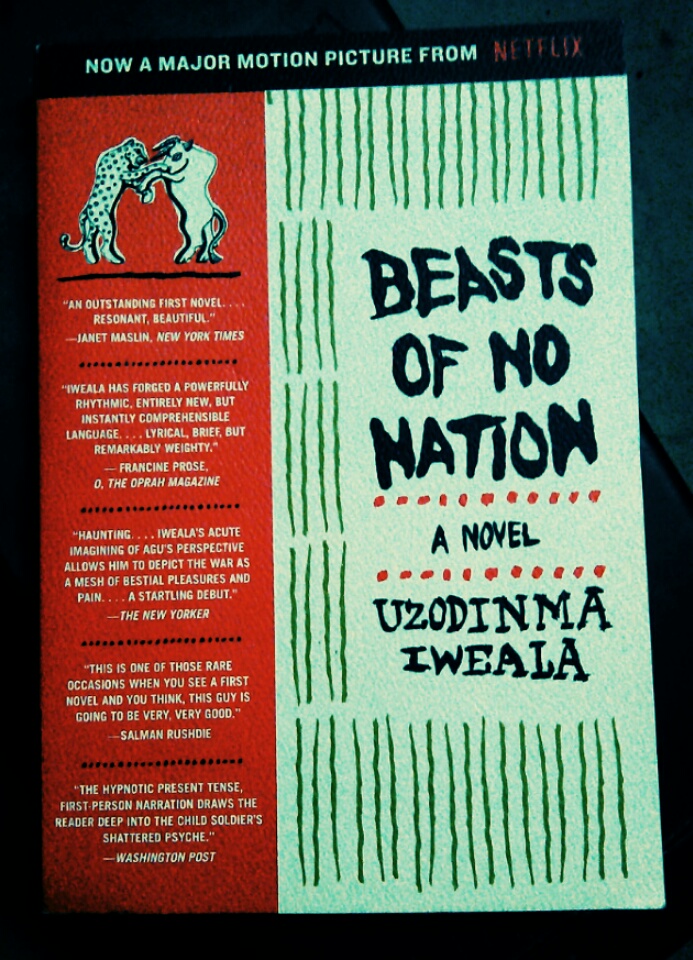
Okay. So one of my reading goals this year is to read more works by women, LGBTQ authors, and authors of color. Part of this is acknowledging my own privilege in that I frequently see people who are at least somewhat like me presented as authors and as characters by those authors. By trying to read authors who are dissimilar to me I'm attempting to broaden my perspective and hear stories from people who have had very different lives than mine. Which is why I'm slightly uncomfortable with the author-subject relationship in Beasts of no Nation. Uzodinma Iweala is an American-born, Harvard-educated man of Nigerian descent who was inspired by a Newsweek article to write a novel about child soldiers in an unspecified African country. In the author interview section at the end of my copy of the book Iweala states that he didn't want to set his novel specifically in Nigeria because he didn't want to reinforce stereotypes about the violence in that country. My question is "how is making the violence generally African any better than making the violence specifically Nigerian?" This seems to be perpetuating the "Africa is a country" attitude seen so frequently in Western film and literature. More problematically Iweala is the son of a wealthy family from a wealthy and generally safe country, and though he has spent time in Nigeria with family and researched his novel by speaking to child soldiers he is as far removed from his main character's history and experience as it is possible to be while still sharing some background experience and vocabulary. I just felt like that needed to be pointed out.

That being said, Beasts of no Nation is an excellent, if horrifying, novel. It tells the story of Agu's recruitment into an army of child soldiers and the horrors he experiences (and becomes nearly numb to) between losing his family and finding himself on a dusty road, starving and scared, near the end of the story. The violence of the story is disconcerting while never seeming unnecessary to communicate the novel's central message (a somewhat on-the-nose point that children who commit atrocities are still children). Agu's isolation, his confusion at the world around him, his memories of his family and the safety of his village, and his clinging to symbols of strength and power are well-crafted and subtle elements of his character that warm you to empathy for the character while holding a hand over your mouth in disgust. Agu's language in particular is an impressive example of craft, a dialect of subject-verb quarrels and repetition mated with pidgin slang and not-quite-right sentence structure keeps the character's immaturity and drifting state in the forefront of the reader's mind.

It's a short novel, so this is going to be a short write-up to keep from utterly spoiling the thing. I was entranced by it, and had trouble putting it down (I read the last 100 pages at a sprint so I could finish it without having to wait for tomorrow); the characters were almost all a fascinating combination of sinister and sympathetic, and the story as a whole brings up some troubling questions about humanity and the terrible things we're capable of. Overall I would recommend Beasts of no Nation, but I'd also like to find some narratives about child soldiers written by people who themselves have experienced the terror and exhaustion of living through a war without the polish of earning multiple degrees from Ivy League universities instead.

Iweala, Uzodinma. Beasts of no Nation. Harper Perennial. New York: New York. 2015. (2005).

Swashbuckling sweetness


Cary Elwes (with help from Joe Layden) has written a charming book about a charming movie. As You Wish is Elwes' memoir about the production of The Princess Bride, which is of course itself an adaptation of the wonderful William Goldman novel of the same name.

Elwes recounts the story of making the sleeper hit with a kind touch, pulling heavily from his co-stars' and production crew's memories of crafting a film that nobody expected to become a family classic. The book is an easy, fast read that never digs too deeply into the nitty-gritty nastiness that's so common in film memoirs but instead recalls friendships formed on sets and touching moments with ROUSs and giants alike.

Everyone who lent their voice to the book is unfailingly sweet, sometimes frustratingly so. Elwes himself is the harshest voice in the book, and even then all his ire is directed inward at his foolishness for injuring himself with a frivolous ATV ride. I had rather hoped that Mandy Patinkin might have something harsh to say about his grueling fencing practice, or that Robin Wright might express some horror at the thought of being set on fire during her first day of filming, but none of that ever happens. As You Wish sets up film-making itself as a fairytale experience (at least with Rob Reiner at the helm) almost on par with the story of Buttercup and Westley. Growing up in LA and visiting film lots and attending at least a couple of auditions I'm inclined to glance askance at this rose-tinted view, but The Princess Bride was an indie film made three decades ago by a bunch of people you only ever hear lovely things about so maybe it was just as great to make as it is to watch.

I'm a bit of a cynic (which is probably sparklingly clear from the general content of this blog) so I found the syrup-sweet "she was great to work with, just an absolute trooper" and "he was a teddy-bear, never got mad, everyone loved him" tone throughout the book a bit taxing, but there are anecdotes scattered in the pages that cracked the shields around my cold and bitter heart. Reading that Wallace Shawn (the clever Sicilian) was acting in constant fear that he'd be fired was endearing, and hearing that Rob Reiner had to be banished from the set while Billy Crystal took his hilarious turn as Miracle Max was certainly something cheerful to think about. Most of what I enjoyed, though, was Elwes and Co. talking about Andre the Giant - telling stories about him messing around on set, describing the tremendous volumes of food and drink he consumed, that was expected; getting a lesson about discrimination and hypervisibility kick-started by a fart on set was wholly unexpected, and one of the best moments of the book.

If you're a fan of The Princess Bride you will probably enjoy Elwes' memoir and appreciate the background details that get filled in through stories from the cast and a lovely set of production stills. If you aren't already a fan there's probably nothing between the covers that will convert you. This book is a decent afternoon's distraction, full of warmth and bright little moments of joy - just like the movie it's about.

Cheers,
     - Alli

Elwes, Cary, with Joe Layden. As You Wish. Touchstone. New York: New York. 2014.

Wednesday, May 18, 2016

I can see the parade


Sol Invictus, the 7th studio album by Faith No More (5th with Mike Patton on vocals), was released on May 18th/19th 2015. I was so excited that I couldn't wait for my preorder copy to show up - I printed out a coupon that Ipecac Recordings had stuck up on FaceBook and drove to the store to get the album after realizing that it wasn't in my mailbox at home. Then I didn't even want to wait to listen to it - I peeled the plastic off in my truck and drove around until "From the Dead" had finished, then started the album again.

My initial response was disappointment - every member of Faith No More is tremendously talented and ground-breaking in his own way. And this album wasn't - it had none of the experimentation of Angel Dust, lacked the steel-and-spit core of Album of the Year, was missing the sneers and flourishes of The Real Thing, and was too homogeneous to recall the delightful genre-dabbling of King For a Day. It didn't feel like my favorite band.

It still doesn't, really.

Oh, there are elements. Some songs have that fucked-up carnival sound that's so common to Mike Patton's catalogue. There's an operatic quality to the piano that you can tell Roddy Bottum was trying to introduce to the music back in the early 80s and is present in nearly every FNM song between now and then. Billy Gould is showing off his impressive chops with virtuoso speed and consistency, but none of the sloppy, sticky funk that hooked me in the first place. Puffy Bordin has put together some nice fills without being flashy (and while being HARD as FUCK). Jon Hudson is, as ever, competent and (perhaps unfortunately) unassuming, not making a mess of anything and occasionally pulling off a very neat technical trick. There are very good things in this album, and to be honest it was still my favorite record last year. It's an incredibly decent forty minutes of rock. It isn't the moody, fussy, face-shredding, irreverent Faith No More we last heard from nearly two decades ago, but the album certainly isn't an embarrassment after all that time. Faith No More may not be the same as they were in the 90s, but only in the sense that they're now elder statesmen and have better things to think about than being naked in front of the computer. Sol Invictus is tidy, it's got a cohesive sound and it all tells basically the same story - a pretty significant departure from the manic genre-hopping FNM is known for. But there are plenty of parts of the album that sound like the old days.

Separation Anxiety and Cone of Shame are brilliant, heavy, perplexing songs that recall hints of tracks like Jizzlobber and Collision; the hilarity and drama of Sunny Side Up mimics the funniest moments of Land of Sunshine and Be Aggressive; The cold country sobriety and warm nostalgia of From the Dead make it seem like a descendant of Take This Bottle.

Sol Invictus is 100% for sure worth a couple of listens, and is fun to return to once in a while, but it's not the kind of album you can't leave behind. Where much of FNM's discography is unforgettable and arresting Sol Invictus is ignorable but contemplative. There's a lot to be examined but you might not care enough to start that examination in the first place.

For an exhaustive song-by-song look at the album, please see the remainder of this incredibly long post. If you don't want to do it then I'll just get to the point: I'd score this album at 80-83 out of 100. At the very least it's a reunion album that doesn't fall victim to rehashing old material and certainly is much better than anyone had any right to expect.

"Sol Invictus"
Sounds like: Lusty monks singing a repentant dirge from a cave slowly filling with saltwater.
Feels like: The opening dance of a tragic ballet.
WTF?: The piano-driven melody and distorted vocals (sometimes half-whispered, sometimes sounding like they're bubbling up from underwater) give an unearthly feel to this track while the half-time tattoo makes it feel like a dirge. I get a strong "Black Hole Sun" vibe off this song, but instead of the intensity of youthful emotion  you hear in BHS, Sol Invictus is a song by a band stained with age and stooped to study the twisting path that brought them to this juncture.
Best Lyric: "Peace ain't coming our way, but the sun keeps burning my face, where's my faith? My blasphemy?"
Score: 7.8/10

"Superhero"
Sounds like: An engine running really well on a bright morning drive.
Feels like: Winning a pissing match against Superman.
WTF?: This is a high-energy song with a call-and-response feeling similar to "Be Aggressive" - it's the meanest track on the album, with lines snarled and drawled and spit into the microphone. That does not, however, make it the hardest song on the album; it's pretty hard though.
Best Lyric: "Leader of men get back in your cage."
Score: 7.6/10

"Sunny Side Up"
Sounds like: A face-melting cereal commercial.
Feels like: A real FNM Song - only song on the album with any funk but still has lots of great piano and howling metal-screaming.
WTF?: One of the great things about Faith No More is that you're never really sure what they're on about. Is this song about fucking? Literal breakfast? Aging? Fuck if I know, and fuck if I care: it's fun to listen to, silly, theatrical, but somehow wistful. It's odd for a song this full of growling and pounding guitars to sound so sweet and open but somehow it manages.
Best Lyric: "Sunny side up, such a lovely way to start the day; sunny side up, dance the night away like Fred Astaire"
Score: 8.9/10

"Separation Anxiety"
Sounds like: Auditory assault.
Feels like: Getting put in a blender where all the blades are Billy Gould's angry black bass.
WTF?: This is four minutes of relentless rythym on the part of Gould, Hudson, and Bordin with lovely decorative/melodic touches from Patton and Bottum.The lilting vocals and solemn keys are a brilliant contrast to the heavy music and abrupt vocal shifts. The song is paranoid and snarling and simpering and writhing; I actually feel it's a pretty good representation of anxiety (and thus it manages to calm me down when I'm panicking).
Best Lyric: "I can't let you go 'cause you're a part of me, not apart from me."
Score: 9.5/10

"Cone of Shame"
Sounds like: Being relentlessly followed down an abandoned midway by a screaming axe-murderer.
Feels like: Angry masturbation
WTF?: The first time I heart this song it confused the fuck out of me - is it a story song, is it a torch song, is it a revenge song? What story is it telling and who is it telling that story to? Then I realized I didn't particularly care - it's got an incredible spooky sound (including samples of Patton's growling dog) and some wonderfully angry lyrics and I love it; it mourns, it howls, it snarls, it hisses, and it pounds its way into your brain where it takes up residence and doesn't ever want to leave.
Best Lyric: "I'm only happy when I'm pissing you off."
Score: 9.8/10

"Rise of the Fall"
Sounds like: A drunk Frenchman became a carnival barker who was then kidnapped by sailors and is singing on deck.
Feels like: A confusing scene in an early Tim Burton film
WTF?: ...That's unfortunate. I'm pretty sure it's the lyrics that kill this for me instead of the music but the lyrics kill it hard - they just don't seem to scan ideally and they're a little too... Expected? Predictable? something. It's nonsense but it isn't good nonsense, which bugs me because I KNOW FNM can produce good nonsense.
Best Lyric: The lyrics suck in this, but the piano and accordion are BITCHIN'.
Score: 6.7/10

"Black Friday"
Sounds like: A mariachi band joined forces with a thrash metal band to write a product jingle.
Feels like: Mike Patton howling all of the sins of conspicuous consumerism out of the world.
WTF?: This is like getting a dildo from your aunt for your 16th birthday. Maybe you wanted it but were surprised to get it and don't quite know what to do with it. You like it, kinda, but it doesn't really do anything and takes a lot of effort on your part to be fun. But for reals, this is a fascinating song that goes to all sorts of odd places - it's got a few moments that are legitimately surprising and entertaining, but the song as a whole is a very strange inclusion.
Best Lyric: "Buy me a future regret, a shrink-wrapped fantasy that I'll want to forget."
Score: 6.8/10

"Motherfucker"
Sounds like: Misanthropy
Feels like: We've probably let everyone down with this whole civilization thing.
WTF?: So it looks like a band that first had a hit with a politically-motivated sneer song is still doing the same thing thirty years later and it still works for them. Motherfucker is full of loathing for the mess we've made of the world and is a subtle demand to fix it.
Best Lyric: All of them are good but the prize of this song goes to the soaring guitar bridge and stuttered "Get-the-mot-ther-fuck-er-onthephone" just past the midpoint. That's a solid fucking moment.
Score: 8.9/10

"Matador"
Sounds like: A melodramatic 80s hair-metal ballad with more distortion.
Feels like: Somebody got a bit too serious with the rock-opera concept.
WTF?: Look it's not hard for lyrics to ruin a song for me and "we will rise from the killing floor, like the matador" both doesn't scan and is too expected; the whole thing just makes me very uncomfortable and there's not much else going on for this song other than a cool ominous bell sound, the rest of it is pretty generic and makes me sad.
Best Lyric: "We will rise from the killing floor," and "let the dead live" - gotta give some credit for snarky self-awareness.
Score: 5.8/10

"From the Dead"
Sounds like: A really grumpy Beatles song, actually - lots of harmonizing and acoustic guitar.
Feels like: A hug from someone you thought you'd never see again.
WTF?: Of all the things that feel like shoutouts to fans in the course of the album this song is the biggest nod. It has musical merit (but it really sounds nothing like Faith No More), sure, but the song isn't about the song, it's about the fact that you got the chance to hear the song.
Best Lyric: "I can see the parade, welcome home my friend, we come back to history in present times, watch your watch unwind" followed by unremitting sobbing because oh my god it's been 18 years and you just weren't expecting this and I'm sorry but I'm just so happy I'm going to need a minute.
Score: 8.1/10

Subtotal: 79.9/100
Bonus Points: 
Reunion album that isn't pure shit +5
No inane solos or self-indulgent jamming (tight shit all the way through) +2
Demerits:
Somewhat cautious, could be more daring -1
Frustrating simplicity of lyrics & bass, unusual for the band -3

Grand Total: 82.9/100
Final Score: B-

I wish I could rate this album higher, it's FNM and I love them and I want everything every member of the band does to be perfect for all time. But that doesn't always happen. Sol Invictus isn't a bad album by any stretch of the imagination, but it isn't in the same league as any of the post-Mosely albums (it's probably fair to put this offering on a level with Introduce Yourself). I'm reviewing Sol Invictus a year late specifically because it took me a while to warm up to it; once I had I wanted to listen to it to the exclusion of all other music for about two months, and now nine months later I can happily listen to the whole thing a couple of times and then forget about it (as a whole) for months. There are a few good songs that stand out on their own and have worked their way into my heavy rotation playlist (mostly "Separation Anxiety" and "Cone of Shame, though "Sunny Side Up" is my weekday alarm) but overall Sol Invictus is a decent, listenable, replayable, and largely forgettable album. I want so hard to love it, I hope that other people out there like it, I hope they love it, I hope the same songs that speak to me speak to them and more, but "pretty okay, good to hear once in a while" is the best that I think this album will ever be for me.

Cheers,
     - Alli