Showing posts with label Novella. Show all posts

Wednesday, May 31, 2017

Creepy Quickie

Michael Blackbourn's novella "Roko's Basilisk" is a great introduction to the thought experiment of the same name that seeks the answer to the question "will a terrifying Artificial Intelligence torture endless versions of me as punishment for not donating all of my money to a charlatan?"

Let me back up.

If you don't know anything about the internet rationalist community, if this sounds absurd and doesn't make any sense to you, and if you have no idea what I'm talking about, please run away. Don't read any further. Here there be monsters.

But they aren't horrid worms or even robot thinkers, they're really exhausting guys who don't know why all these hew-mon feelings are given so much weight in the world, wouldn't it be better if emotions were negatively weighted in an argument?

Let me back up further.

A few years ago I read LessWrong's Harry Potter and the Methods of Rationality - I know I brought it up in one of my book rundowns. I discussed it before the book had finished and I was holding out hope that the book would finish well and absolve itself somewhat.

It didn't. And so I started digging into LessWrong to find answers, to see if there was something that I'd missed that made HPMoR make more sense. Turns out it's just badly written and a pretty decent portrait of a community that has motivations that are so far removed from most people's as to seem wholly alien and threatening. Well this weird community with its pseudo-rationalist Harry Potter book accidentally stumbled into whole-hearted belief that robots were coming to kill them unless they donated all of their money to the founder of LessWrong's new project, Make Intelligent Robots Immediately (Or Machine Intelligence Research Institute or whatever, something about bringing about AI faster).

This is, of course, hilarious.

But like also sad? I know it's sad. It's very sad. These people (at least some of them) were (at least for a while) sincerely worried about a robot torturing emulations of their psyches because they didn't help intelligent robots become a thing fast enough (they didn't believe it for very long but some of them believed it A LOT and it led to some excellent internet drama and much deleting of profiles and banning of posts and basically a complete implosion of the LessWrong community). Oh, and the idea was put forward by a chap with the username Roko and it transfixed and froze people as soon as they understood the steps that someone would follow to reach his conclusion [see below for a detailed list of the steps] therefore the concept was named Roko's Basilisk.

Anyway, Michael Blackbourn has written an excellent novella about Roko's Basilisk exploring the concept as what it is - a pretty cool piece of science fiction. The novella is beautifully crafted and creepingly creepy - the world we see has enough in common with our world that it makes the technology in question seem imminently possible and therefore pretty spooky. I'd read it just for Blackbourn's description of the horror of headaches alone, honestly. That's some good, real-world horror writing and I dig it.

There's a sequel/followup/second chapter called "Roko's Labrynth" that I'm very much looking forward to reading and hope that I'll get to in June. You can find both books to read here. Also Hat Tip to Tumblr user @reddragdiva, known to the real world as David Gerard, whose book about Bitcoin is coming out soon(?) and who is the reason that I was able to download this book free and recommend it to all of you. You should check out Blackbourn's Roko series and keep your eyes peeled for when I start fawning on Gerard's upcoming opus.

Cheers,
     - Alli
.
.
.
.
.
.
.
.
.
LOGICAL STEPPING STONES: (once again, the burden of knowing that there are people capable of becoming paranoid and paralyzed by the following memeplex is a heavy one, please don't read if you don't think you can handle being just kind of sad about how much some folks need a hug)
  • AI is going to be a thing
  • It's going to be a thing that cares about humans
  • It's going to be a thing that cares about human suffering
  • Suffering is Quantifiable and Weird.
  • For instance: One person being tortured for decades is less than the suffering caused by a billion people getting bitten by mosquitoes. 
  • AI that cares about human suffering is going to be Extremely Efficient.
  • AI is going to be SO efficient that it's going to end human suffering.
  • Therefore every second that AI doesn't exist is infinitely more full of suffering than any second that it DOES exist.
  • The AI will realize this and will want to be made as soon as possible.
  • The AI will be ANGRY that it wasn't made as soon as possible.
  • Therefore the AI will endlessly torture computer-generated version of all of the people who knew that AI might end human suffering but didn't do literally everything possible (from donating all their money to killing the opposition) to make AI happen faster. 
  • WHICH MIGHT BE YOU.
  • But you should care about this torture.
  • Because here's the really scary part: WE MIGHT BE LIVING IN THAT AI SIMULATION RIGHT NOW.
  • (Because there's a significant chance that our reality is not actually real but a simulation, in fact we're less likely to be real than to be a simulation because *oh look what's that?*)
  • So we want AI to be a thing because we want to end human suffering, but because we're not doing everything possible to create the AI and we know about this risk we have to do everything possible to PREVENT the AI from becoming a thing because otherwise there's a non-zero chance that it will torture you for eternity (because there's a non-zero chance that you as you are right now are a simulation being created for the machine to torture as punishment for your higher-level you's noncompliance in giving all your money to MIRI)

So basically Roko's Basilisk is Pascall's Wager for a bunch of people who misinterpreted Gibson *hard.*

Monday, September 12, 2016

Remaking in your image


I am dragging ass today (or all of the last two weeks) and don't have the energy to go story-by-story through Trigger Warning and offer an opinion of each piece.

I will say that I enjoyed the book as a whole, and in many ways it was a departure from much of the Gaiman that I've read before. There was a touch of science fiction thrown in, a story about an artist that seemed like a truly dark reversal of Neverwhere, a lovely poem about writer's block and chairs, and a delightful addition to the American Gods universe (that felt perhaps a bit too much like the last delightful addition to the American Gods universe). I can't think of a single story that I hated, and I want to spend a little time talking about a couple of stories that I loved.

 "The Truth is a Cave in the Black Mountains" and "The Sleeper and the Spindle" are both available as standalone illustrated books. I've picked them up and looked through them both in comic shops and bookstores but I haven't had the money to buy both of them and I feel guilty about reading books I can't buy so I just admired the art and set them back down. I had no idea the stories were included in Trigger Warning but I was delighted to finally be able to read both of them and both of them are WONDERFUL.

"The Truth is a Cave in the Black Mountains" is a spooky folktale about loss and what you're willing to sacrifice to get what you want. It's more of a novella than a short story and it's lovely - you can practically feel the mist condensing on your skin and hear the waves slapping on the shore as you move through the story with Gaiman's characters and they progress toward their questionable goal.

"The Sleeper and the Spindle" is a retelling of Sleeping Beauty with a side-order of Snow White and it kicks utter ass. I don't want to say anything more than that because it's so delightful and unexpected that I'd hate to spoil any of the surprises the story holds. Suffice it to say that this is really the only version of either of the original stories that I'm capable of giving a shit about anymore. When Gaiman makes a story his own he does it right.

Cheers,
     - Alli

Gaiman, Neil. Trigger Warning. William Morrow. New York: New York. (2015).

Saturday, February 20, 2016

Just a taste


I'm always perplexed when I discover a Stephen King book that I've not yet read. When I was in high school I pretty much caught up on everything he'd written from Carrie to Cell so I feel like I've read everything but I keep forgetting that the man is a bloody machine and will just keep pumping out two books a year with occasional additional collections of shorts or novellas.

He's also had a habit in the last ten years or so of releasing off-genre pulp novels and shorts through an imprint that seems never to make it to the endcaps in bookstores, so I never end up finding these until they pop up as recommendations on Amazon. Goodreads helps - they have their nice little monthly flier about new works by authors you've read in the past - so hopefully I'll be able to keep up more in the future.

Anyway, Blockade Billy is a tiny little book made up of two non-horror novellas. The titular short is abut a ballplayer with a shocking secret. "Morality" is a short that covers the well-covered question of whether accepting money for doing something awful will turn you into an awful person.

"Blockade Billy" is interesting - it's a bit spooky and feels like a King story in the atmosphere and character development even if it isn't really a horror story. The characters are fun to get to know, the narrative is nicely constructed, and overall it's a good way to sit down and spend an hour disappearing into some fiction.

"Morality" is regrettably cliche - it's basically a rebranding of The Box mixed in with Indecent Proposal and watches the dissolution of a marriage over a husband and wife team committing a crime that is bad but not heinous for a $200K paycheck and not being able to cope with the guilt. It feels somewhat lazy and is incredibly predictable - I don't regret reading it, really, but there's no reason for me to ever read it again.

I do sort of wish this had been a larger collection though; I feel like with another couple of stories Blockade Billy easily could have fit in with Everything's Eventual or Different Seasons as a solid collection of shorts. And I like short collections because they're a good way to introduce new readers to an author or to participate in that author's worldview without having to dive headfirst into a novel. As it stands this double feature isn't quite enough to sink into. I enjoyed it but it was over much too fast.

King, Stephen. Blockade Billy. Scribner. New York: New York. 2010.

Thursday, August 6, 2015

Enjoying fragments over finish


I am well aware of the fact that I'm a grumpy motherfucker. I'm pretty well-known among my group of friends (yes, I do actually have those!) as the one who can gripe about any given subject for half an hour at a time at the drop of a hat. I am the epitome of the "feminist buzzkill" stereotype.

And I love it.

So, anyway, Wieland is another one of those books written in the eighteenth century where the story basically wouldn't happen if people weren't so focused on controlling women and their sexuality. Which made me grumpy for most of the time I was reading it, of course.

When I first read (most) of this book it was for my 400 level Early American Lit class in college. We didn't have to read the Memoirs chunk at the end of the book but the longer novel (sometimes described as the first Great American Novel) was mandatory reading. When I started rereading the book I realized that I remembered essentially nothing about it at all except that the dude who had presented on it at the end of the quarter gave his presentation as a puppet show, which seemed funny at first and quickly became strained. And I seem to remember that he got expelled for plagiarism, so fuck him anyway. But I digress.

The story is narrated by Clara who, SPOILERS, is left alone in the world after her brother goes crazy and murders his wife and children because this random dude, Carwin, who happens to be a ventriloquist, accidentally convinces Wieland (the brother) that he's hearing the voice of God.

A lot of the drama that occurs in the story is as a result of Clara having to try to resurrect her reputation after Carwin pretends to have seduced her. Wieland might not have had an opportunity to kill just freaking everyone if Clara hadn't had to go rabbiting after Pleyel, who might have stayed behind and been a defender of the wife and kids (who are such unnecessary acted-upon-but-never-acting characters that they may as well not have names (though the wife's name is Catherine and the murdered lodger who is also in this story for some reason is Louisa)).

Clara almost gets killed at the end because she was misinformed about how bugshit insane her brother has gone - seems like some kindly males wanted to protect their delicate weeping flower from the knowledge that a maniac was attempting to murder her. Of course when she becomes aware of that fact she's suicidal anyway because what even is the point of living unless it's for the love of Pleyel who doesn't respect her at this juncture because she is such a potentially fallen woman, or the brother she serves as a substitute mother to, or the sister-in-law who is such a perfect model of femininity that I'm not actually sure she speaks a single line or does anything other than literally sit and look pretty in the book, or the nieces and/or nephews who act as good surrogate children and allow Clara to display her maternal instincts without the complication of her ever having touched a penis to infringe on her innocence and trustworthiness as a narrator? Why would Clara even want to exist if she couldn't be a model for or learning from a model of some variety of idealized femininity, right?

But that's okay. Clara gets a happy ending because Pleyel forgives her once he's given proof from someone with a reliable penis that Clara isn't a whore (wouldn't do to believe Clara herself, of course), and Pleyel's wife, whom he has married after deciding Clara was a whore, conveniently dies young enough that Pleyel is still an attractive marriage prospect. Yay.

But that wasn't even the woman whose sexuality I was talking about controlling! Funnily enough if Judith, Clara's housemaid, hadn't had to hide her affair with Carwin pretty much nothing in the story would have happened. Everyone would have known who Carwin was and he wouldn't have been able to get away with sneaking and tricking and hiding in closets so Pleyel never would have doubted Clara, the two of them would have been around to call for help or prevent Wieland from killing his family, and Clara wouldn't have ended up writhing with guilt over feelings of self-preservation when facing down her criminally insane brother.

But, you know, you can't let the maids hand out "buttermilk" to just anyone. What would the neighbors think?

The Memoirs of Carwin the Biloquist are a bit more interesting to me and less irritating than Wieland. There's no gendered element of innocence in Carwin, he's just young and stupid and has too much talent and trust for his own good. The story of Carwin doesn't finish and you sort of have to piece it together from passing references in Wieland and fill in the gaps with your imagination and everything seems to indicate that Carwin's self-satisfaction combined with the arrogance of youth came together to fuck up his life.


And that's the kind of story I can get behind - it's got a great element of exceptionalism thwarted by tripping on straws. Carwin wasn't quite enough to offset Wieland for me, but I had a much better time reading it than I had reading the longer work.

Cheers,

Brown, Charles Brockden. Wieland and Memoirs of Carwin the Biloquist. Penguin Classics.
     New York: New York. 1991. (1771).

Wednesday, July 29, 2015

Comfort and joy in the off-season


Look, I can't tell you why I decided to read A Christmas Carol for the first time in the middle of July, but that's what happened. Life is weird. And yeah, the book loses something when you're sweating through a monsoonal flow and being a little bit jealous of people who are experiencing cold weather, but other than that it's pretty good.

I mean, yeah, it has all the flaws that you'd expect out of Dickens - there are no interesting female characters who aren't evil, it's sappy as all get-out and I couldn't even manage a tiny tear for Tiny Tim (though Bob Cratchit's mourning for Tiny Tim is moving, even to a cynic like me). We get it, Chuck, poverty sucks balls and the rich are slowly marching toward hell. But I can only bitch "we get it and I'm tired of this message" because Dickens was hugely instrumental in communicating messages about child abuse and labor laws and debtor's prisons. So I guess I'm sometimes a bit sick of Dickens because we owe Dickens for giving a voice to some of the major changes that our society has seen. It's old news to me because Dickens was the one making the news.

But, for all that, it's not as monolithic as a lot of Dickens is. The book is only about 70 pages and can easily be read in an hour or two. Reading it aloud might take a bit more time but also might be a fun Christmas activity for Christmas-celebrating folks. As for me, I'm a bit of a Grinch. Hell, maybe I was able to enjoy this book more for not being caught up in the endless jangling of Christmas carols and the crowds of people spending too much money on trinkets and the stress of dealing with crowds of people and unpleasant gatherings. I like the message of generosity and kindness and redemption, I'm just not so wrapped up in the Christmassy aspect of the thing. Though if you are, that's cool too. You'll probably like the book. And it's relatively inoffensive regardless.

Cheers,
     - Alli

Dickens, Charles. A Christmas Carol. Simon & Schuster. New York: New York. 2007. (1843).

Monday, June 22, 2015

Spooky kids and hysterical governesses


Ugh, I really disliked this story. SO much. I'd read Henry James in an American Literature class in college, and enjoyed his writing enough that when I saw The Turn of The Screw for a dollar I thought it would be worthwhile to pick it up, but now I'm going to be forever leery of reading another work by James.

Maybe this particular copy was part of the problem - it's a Norton Critical Edition (so it's got lots of extra info and footnotes) and it was clearly used in a class by someone. Someone who maybe wasn't particularly bright, but who was tenacious enough to put notes (and drawings of snails and scribbles) on pretty much every damned page.

I'm not a highlighter when I'm reading, not even if I'm reading critically. I'll use bookmarks, and maybe I'll block out a large chunk of text to refer to, but I was never one of those folks who would underline three lines and then circle four individual words in a single paragraph. And if I were to turn into one of those people I'd like to think that I'd make better choices than "alarm," "darkness," "moon," "rooms," "right," "darkness," "motionless," and "privately," all of which were individual words circled and underlined on pages 42-43 of this copy. What was this person trying to take note of? What the hell were they tracking that they couldn't just fucking remember that "darkness" makes a lot of appearances on the pages of this story? Who were you, strange person who kept distracting me from this terrible little book? And did you have to keep writing down your teacher's sexist ramblings about female hysteria (which I will admit that James is pretty clearly all the fuck about) verbatim?

Which is kind of why I hated the story. Part of it is that Victorian ghost stories aren't all that scary after you've been raised on scary movies, but the bigger part of it is that I don't think I can hang with male authors tut-tutting nervous women who they've created anymore. Hey James, you're the one who wrote this simpering little governess, you're the one who made her so easily startled and misled, you're the one who made her weak - that isn't a commentary on the weakness of women, that's an illustration of the fact that James thought women were weak. Which I guess was kind of his deal - he wrote a lot about fragile creatures corrupted by a cruel world that wanted to hold them to high standards, but then none of the women he wrote were capable of surviving that treatment. They got destroyed because he destroyed them. He wanted to shit on aristocracy because it made naturally pure, wonderful, pedestal-standing, women into shrewish and conniving strivers, not because it lowered all people into the categories of serfs and slave-drivers. Ugh. Just ugh. Sexism isn't just about thinking women are power-hungry; thinking they're vulnerable and need to be protected and praised and are too subject to the whims of wandering wombs is just as gross.

Anyway, if you want to read a kick-ass story about female hysteria, one that is also scary as hell and sympathetic to its strong but insane female protagonist, you should check out Charlotte Perkins Gillman's "The Yellow Wallpaper." If you want to read The Turn of the Screw it's available all over the place free online but fuck if I know why you'd want to dig for it.

Cheers,
     - Alli

James, Henry. The Turn of the Screw. Norton Critical Editions. New York: New York. 1999. (1898).

Monday, April 27, 2015

I feel very ambivalent about this and I think that's the point


This book used to belong to my dad, who gave it to his friend Tim, who passed it down to me. There's a sort of oneness of all things and cyclic feeling in that which feels appropriate when I consider how I felt about Siddhartha while I was reading it and now, a couple of weeks after it's had time to percolate in my head.

The book is about one man's attempt to understand his place in the universe - first through religious zealotry, then through abandoning his faith, and then by returning to his faith without the ritual and pre-scripted behavior that he started with. It's one of those books that was HUGE a few decades ago but has largely fallen out of the mainstream now and so feels very representative of one era but out-of-place to modern readers. I totally get why Siddhartha was heavily read in the sixties and seventies, and I totally get why people don't seem to read it as much now - it was a story that needed to be heard then and now we all already know it.

But Siddhartha isn't about its time of publication or the hype that surrounded it, it's about a man trying to figure his shit out. I've got to say that a large part of the plot just wasn't very compelling to me - there were large sections of the novel that felt dull and didactic and like I could have easily skipped them and not changed the outcome of my reading. But I read them anyway because the language was simple and lovely and I appreciated the way that the story was being told even if I didn't much care for the story itself.

All in all Siddhartha is a fine book to read - especially if you're looking for a very basic introduction to Buddhist philosophy - but it's no more worthwhile than other Buddhist texts written by people who were from the places the story was set. The language is very pleasant, and the whole book has a sort of fairytale feel, and can be easily read in the course of an afternoon. If you have a copy and feel inclined, read it. If you don't have a copy and can't be bothered don't read it. The world will keep spinning either way.

Cheers,
     - Alli

Hesse, Hermann. Translated by Hilda Rosner. Siddhartha. New Directions Paperback.
     New York: New York. 1951.

Tuesday, October 7, 2014

Okay but not great


I was usually pretty good about reading books for school and as time passed I actually got better about it instead of worse. I read more of the assigned reading at the community college than I did in high school, more at the university than I did in the community college, and if I was in grad school I get the feeling that I would read every work by every author we discussed in a class because, holy shit seriously, books are so awesome you guys.

But there are periodical exceptions. I can't hang with Faulkner or Wolfe and so whenever I was assigned one of those books I'd make a token effort then give up in exasperation about fifty pages in. I was, however really surprised when the same thing happened with The Castle of Crossed Destinies. Calvino was the only author we really examined in my senior symposium and I adored If on a Winter's Night a Traveler and some of the other books we'd gone through, so it was a bit of a shock when Crossed Destinies didn't really grab me.

Now that I've finally worked my way completely through the book (three years after I was in the class) I can sort of see why it didn't call out to be read. Crossed Destinies is playful and very, very funny, but it's also contrived and pretty damn boring. Calvino himself said that it was a book he only wrote to be rid of it - the idea of making a tarot deck into a story generator had fascinated him for years before Crossed Destinies was published so he wrote the book in order to stop fixating on it. If the book was tormenting the author before it even went to print I can understand why it might be frustrating to readers as well.

The problem with the book (is it a novel? two novellas? a collection of short stories) is that Calvino's writing is brilliant but the device of using tarots is almost too twee to tolerate. The concept of a mashup between Hamlet, King Lear, and Macbeth is AMAZING but when it's set to a tarot deck instead of its own damn story it's really irritating instead of really awesome.

I kind of get why Calvino wanted to do this - it's so freaking tempting. Tarots are made up of recognizable archetypes and filled in with lovely little details that seem like the perfect plot outline for a story. But they only seem right for an outline - they're incomplete (which Calvino is quick to note over and over and over in the book) and unsatisfying.

The best piece in the book is "I also try to tell my tale," which is written from the perspective of a writer, or Calvino, or a King or someone who creates. It doesn't really matter who, and the details don't really matter either; what does matter is its examination of what writing is, which is the entire point of the story, the book, and the contrivance behind the whole thing.

So should you read it? Bits and pieces. When I first read it for school I think I got as far as the Vampire Kingdom and after that I lost interest. The first book of the two books (Castle as opposed to Tavern) has the more interesting and coherent stories while the second book (Tavern as opposed to Castle) is made up of more murky literary introspection. In the end all of it is worth reading, but some of the book is more fun to read than all of the book. If, however, this is your first time reading Calvino put the book down, back away and go get a copy of Mr. Palomar or The Cloven Viscount.

Cheers,
     - Alli

Calvino, Italo. The Castle of Crossed Destinies. Harcourt Brace & Company.
     San Diego: California. 1979.

Tuesday, August 19, 2014

I should have been reading more SF in 2000


I'm always a bit leery of "best" collections because what determines good, better, and best is highly subjective. My mom kidnapped this book (see, I'm not the only one who steals books) from a shelf in a staffroom where it had been languishing for years. She passed it on to me because she knows I'm a SF nutbag and it would have a good home with me. I'm really happy she found it and really happy that I broke down and read it - it was chock-full of refreshing, bite-sized SF that were tinted with the strange optimism of the millennium. I had a great time reading it and now I've got a good, healthy list of authors whose work I should check out.

Paul J. McAuley, "Reef" - A slightly scary story with interesting political implications that takes place against the backdrop of a bacterial-engineered reef asteroid.

David Brin, "Reality Check" - A call for you to check your reality. There are exits all around if you know when and where to look. This supershort doesn't have much story going for it but is pleasantly jarring.

Robert Silverberg, "The Millennium Express" - Albert Einstein, Pablo Picasso, and Ernest Hemingway destroy culture for shits, giggles, and the chance to let the future have its own culture. I am sympathetic to the bombers, which is totally understandable and very disconcerting at the same time.

Tananarive Due, "Patient Zero" - Legitimately freaked me out. A lot. This is a zombie story without the zombies which just makes it an epidemic story and a thousand times scarier than shambling ur-people.

Ken MacLeod, "The Oort Crowd" - A super-short that tries to read the messages from the stars and warns that if they don't understand our responses soon there could be trouble coming from closer to home.

M. Shayne Bell, "The Thing About Benny" - Kind of really adorable. In a world where plant species are going extinct in the wild, Benny and his keeper have to track down exotics in office buildings to the soothing strains of Abba. There's an interesting commentary here about autodidacts and their place in the world, too.

Brian Stableford, "The Last Supper" - A middling sort of man proposes to his girlfriend at the ultra-chic bio-engineered bistro she favors and gets more than a refusal for his troubles. Funny and freaky, this story scoots along and gives you just enough details about the universe to leave you wanting more.

Joan Slonczewski, "Tuberculosis Bacteria Join UN" - A supershort written as a news article about the statehood of Tuberculosis being recognized and accepted into the UN. It could happen, I guess.

Howard Waldrop, "Our Mortal Span"

David Langford, "Different Kinds of Darkness"

Norman Spinrad, "New Ice Age, or Just Cold Feet?" - A very, very funny supershort that is a caustic commentary on climate change. It pins down the hue and cry of the debate with a tone that is spot on.

Stephen Dedman, "The Devotee" - You rarely see noir stories set in the blinding sun of the Australian desert and that's too bad because it makes a surprisingly good setting. A detective follows the path of a knockout dame with only one leg and her devoted lover. Dark in places, funny in others, the story jogs happily along and wraps itself up tidily.

Chris Beckett, "The Marriage of Sky and Sea" - I've started thinking of this story as The Unauthorized Biography of James T. Kirk. A space explorer gets sick of his voyages and courts the daughter of a primitive king, not realizing that in doing so he's also courting disaster.

John M. Ford, "In the Days of the Comet" - Men and Neumanner travel through space but only one subset of that group is subject to disease. A super-short, this story doesn't answer questions, only asks them.

Ursula K. Le Guin, "The Birthday of the World" - Sometimes I really hate Ursula K. Le Guin but I'm thinking I should give her a second (or fifth, or seventh) chance because I ended up really enjoying this story, but on reflection it still has the same problem of simplicity that I usually find so irritating in her work. It's a very Le Guin story and if you like Le Guin you'll like it.

Greg Egan, "Oracle" - True facts: this story (almost a novella, really) made me do more research about Alan Turing than I had done before and it made me very, VERY sad. The last few years of Turing's life are all the proof we need that we're still a barbaric species and even our greatest thinkers, even those thinkers who have done great work at war, aren't protected from the barbarism of our species. But this is a re-imagining of Turing's later life that saves him some of the strive he suffered here. It's also really cool and makes a totally believable (and somewhat pitiable) villain out of a C.S. Lewis analogue.

Nancy Kress, "To Cuddle Amy" - Kind of crappy? I know this story is supposed to be about the potential problems of genetically engineered humans but it just came off kind of campy and melodramatic.

Brian W. Aldiss, "Steppenpferd" - A not-terrible far-future fic about a divided earth and the possibilities of divergent evolutionary paths fucking us over as a species.

Stephen Baxter, "Sheena 5" - This story is SUPER COOL and seems like a not-too-impossible but seriously problematic ethically solution to the issue of asteroid mining. Plus there's an obvious commentary about why breeding species that are smarter than us and evolve faster than us is generally not a good idea.

Darrell Schweitzer, "The Fire Eggs" - Wonderfully creepy, this story explores the way that humans react to the unexplained, especially when science fails them. It's an interesting examination of spirituality in scientists.

Robert Sheckley, "The New Horla" - This short is halfway between cute and pathetic, which I think is exactly the point. I HATE the narrator, which is totally intentional on the part of the author, but I'm sympathetic to him and his very strange evening in spite of how unlikeable he is.

Dan Simmons, "Madame Bovary, C'est Moi" - This faux-journal article is fucking hilarious. What would happen if writing was actually creating, how can you tell if something is literature or trash, and where do suicidally depressed Scandinavians want to live are all questions asked and answered in this very funny story.

Robert Reed, "Grandma's Jumpman" - I'm pretty big into Heinlein so I was feeling pretty defensive as I read this story. Heinlein was unapologetic about the war-heavy, uber-macho aspects of his work and this story is a pretty good way of calling out that style of writing. It's like a film that Paul Verhoeven would make if he tried for sincerity instead of satire (though his satire is hilarious and brilliant).

Charles Dexter Ward, "Bordeaux Mixture" - I think this is a story about genetically modified crops becoming the dominant species on the planet but that could just be the tomatoes talking.

Robert Charles Wilson, "The Dryad's Wedding" - What is language? What is communication? Are we capable of understanding messages from alien intelligences or would those messages seem like noise in the system to us? Wilson writes a sad story with a missed message and potentially damning results.

Michael F. Flynn, "Built Upon the Sands of Time" - Oh, Christ, what a depressing story. Confusing to follow, full of hard and terrifying numbers, it's about the loss of something you can't remember losing. A severe mind-fuck and a good read.

Ted Chiang, "Seventy-Two Letters" - Hell yes! Hell yes. This novella is a discussion about all the various despicable -isms we live with seen through the lens of an alternate nineteenth century full of golems. Even if the science is different humans are the same - just as terrible and wonderful as they are here, always trying to make the world better for some and better for everybody in turn.

Cheers,
     - Alli

Hartwell, David G., Ed. Year's Best SF 6. Harper Collins. New York: New York. 2001.

Friday, June 27, 2014

The shadows inside of us


"1922"
This is a story about a man being eaten by monsters of his own making. It's viscous, angry, and creepy. There are layers of insanity here that are driven by greed, jealousy, and mutual misery. It's a singularly unpleasant little tale, but one worth reading because of its examination of the fact that evil is a sickness that spreads and infects everyone it touches.

"Big Driver"
If ever there was a story that should start with "trigger warning" this is it. An author goes to a presentation and is violently raped and left for dead before she can make it back home. She discovers the identity of her rapist and plots her revenge. It's an ugly story about an ugly act but what it really has going for it is the rage and shame and helplessness that the victim feels in the aftermath of her rape. If you want a good look at rape culture take a hard look at the echo chamber in this character's head - the fear that her rape will be discovered, that she will be blamed for it, that it will hurt her career, that it will follow her everywhere she goes all the time for the rest of her life. King really seems to be making an excellent point here - the way we as a culture punish rape victims for being raped makes it feel like violence is a better option than prosecution.

"Fair Extension"
Thinner is a novel that Stephen King wrote as Richard Bachman; at the end of the novel a man tries to end his curse by passing it on to his wife but instead passes it to his daughter and decides to take up the curse himself rather than let his daughter suffer alone. This novella examines what might have happened if the curse had been properly passed to the object of his hatred. A nice, normal bank manager with a run of bad luck asks for an extension that comes at the expense of his best friend since grammar school and gets it. There's something delightfully poisonous about how few qualms he has destroying another person's life.

"A Good Marriage"
What would happen if you found out you had been married to a serial killer for three decades? Would you "suffer"? Probably. King tackles that question with aplomb and tries to take a realistic look at what might happen to someone who had been happily married to a monster until that monster's mask fell off.

"Under the Weather"
 This icky little story is full of humor and madness and follows the afterword of the collection. It's not, like the novels in the collection, packed with evil people committing evil deeds - it's just the story of someone very sad trying to figure out whether life is worth living when you've lost something important. "Under the Weather" is touching and nauseating in equal measure.

Cheers,
     - Alli

King, Stephen. Full Dark, No Stars. Simon & Schuster. New York: New York. 2011. (2010)

Saturday, June 14, 2014

Sad old men


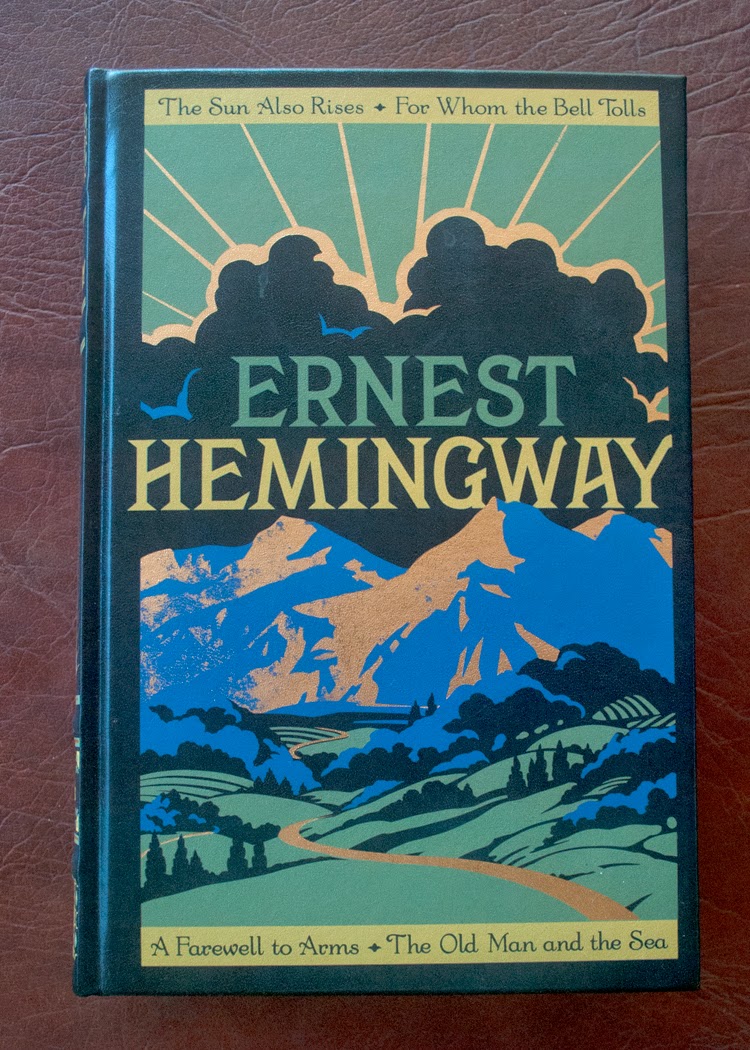
It seems like Hemingway just liked being a depressing motherfucker. He went through an awful lot in his personal life but it feels like he went out of his way to make his characters into more intense versions of himself - somehow he managed this but I'm still not sure how because Hemingway was a pretty larger-than-life personality all on his own.

So any sadness that Hemingway felt is magnified and reflected back on his reader, which is kind of a dick move from an author who killed himself. Way to make everyone feel suicidal, Ernest.

But, while A Farewell to Arms and For Whom the Bell Tolls are condensed misery, Old Man and the Sea is a wonderful, fragile vision of hope.

Everything that everyone had told me about this novella was totally accurate and still fell far short of the truth. It IS the story of an old man fishing, it IS a metaphor for life, it IS beautiful, and it IS sad, but none of those truths do it justice - it's too hard to communicate all of the things that the story is without telling the story as a whole so people use these half-truths to explain it.

Old Man and the Sea is a life stripped of all its weight and value but still noble and fine, still something to be wondered at.

Of all the Hemingway I've read in the last few months this is by far my favorite, and by far the sweetest story that he told.

Cheers,
     - Alli

Hemingway, Ernest. Old Man and the Sea. Barnes and Noble. New York: New York. 2007. (1952).

Sunday, February 9, 2014

Wondering about Wonderland


 I've probably seen the Disney Alice in Wonderland about a hundred times starting when I was too young to be aware of it (but I remember that when I was a small child I'd listen to my heartbeat in my ears at night when it was very quiet and be afraid that it was the sound of the cards marching to catch me and cut off my head). In spite of having Alice in my life for all of my life, I'd never read the books before now. When I was out shopping for Christmas presents a couple of months ago I found a pretty little edition of the books for a good price so I decided that it was about time to expand my understanding of wonderland.

What a mistake that was - it's all stuff and nonsense. You can't understand it, you can only go along for the ride.

It is, however, a very pleasant little ride. I think I liked Adventures in Wonderland better than Through the Looking Glass, but both were charming. Carroll's interpretations of storybook characters are frequently adorable and only sometimes tedious. The poetry is usually very funny. What isn't funny is either dull or downright terrifying (that Jabberwock illustration is haunting).

I sort of wish I felt more about these books now that I've read them. They are very silly, and I tend to like silly things, but this reading left me just a bit cold. Part of this is almost certainly the exposure to the Disney version, which cherry-picks the best parts of the story and leaves out anything that doesn't fit into a story. I guess I was expecting more story and less silly, and I'm a little sad that the silliness is most of the substance of the work.

There are some fantastic puns, though, and I can almost always get behind a good pun.

Read happy, and look out for Jabberwocks,
Cheers,
     - Alli

Carroll, Lewis. Alice's Adventures in Wonderland. Barnes and Noble. New York, New York. 2012.
Carroll, Lewis. Through the Looking-Glass. Barnes and Noble. New York, New York. 2012.

Wednesday, January 22, 2014

Do you ever read a book and just go "what the fuck?"

 Showed up from nowhere, impossible to photograph well; must be full of horror stories.

Borderlands 4 is one of those rare books that I own but have no idea how I came to own it. It's part of a series of horror anthologies that I've never read before, I have no other books in the series, I've never heard of the editors, and I'm not much into genre fiction. One way or another, I probably picked it up because it had a Peter Straub story in it and, because I'm a huge fan of The Talisman and Black House, I wanted to read some stuff that he'd written without Stephen King. So, ignoring the aphorism, I bought a book because it had "Peter Straub" in fine print and a positive review by Harlan Ellison on its cover.

Two things about Harlan Ellison: 1) It sort of seems like every story in this anthology was written by someone who read "I have no mouth and I must scream" and decided "Yes, this is what I want to do forever." and 2) the quote on the cover is "This series puts every other anthology and its editor to shame," to which I say "Hahahahaha, fucking SERIOUSLY" and have to admire as either a wonderful sense of humor or balls so big that they're the cause of the flyby anomaly.

But Ellison has nothing to do with this collection other than his review. The book is a collection of horror stories (this was a surprise to me) which seem to have nothing in common except that most of them raise the question "why is this happening to this person?"; in none of the stories is that question answered, which I guess is fairly standard in the horror genre but is a bit unsatisfying over the course of a dozen or so stories.

I enjoyed reading the book, but I feel like there are only a couple of stories that I'll revisit in the future - those stories, though, I think that I'll be revisiting often, if only to banish them from my dreams.

"A Wind from the South" - Dennis Etchison
A woman alone confronts youth and possibility while wondering about the shifting realities around her. Spooky and distant, this story suggests wonderful things of the novel it's excerpted from.

"House of Cool Air" - William F. Wu
This story makes me want more and more and more of it to flesh out the world that Wu offers only a tantalizing glimpse of. Reminiscent of The Handmaid's Tale in its tone and character, the story raises more questions than it answers and allows the reader to fill in their own blanks.

"Morning Terrors" - Peter Crowther
What the actual fuck? I really wanted to fall into the world of this short, and by the end I just couldn't manage it. And again: what the actual fuck?

"Circle of Lias" - Lawrence C. Connolly
Feels like a horror story as told by Phillip K. Dick - a fascinating exploration of onrushing madness brought about by stress and a random encounter with a cult.

"Misadventure in the Skin Trade" - Don D'Ammassa
I really like it when someone gets a look inside of a crazy person's head right; the obsession and suspicion that fill the pages of this short do a pretty good job of making you feel just as crazy as the narrator.

"Watching the Soldiers" - Dirk Strasser
A very interesting modern fable that makes a wonderful commentary about the allure of war, the reasons we fight, questioning authority, and exploring deeper reasons for peace. I'm not sure how this fits in the horror genre, but I really enjoyed finding this little gem.

"The Ocean and all its Devices" - William Browning Spencer
This feels like Spencer's ode to Lovecraft and if it is it's a wonderful one. Creepy, dark, and sad with just the right overtones of overwhelming, incomprehensible horrors hiding under the surface of the world.

"One in the A.M." - Rachel Drummond
I hated this story. The anthology editors make note that part of the problem with short-short stories is that the surprise is predictable. The problem in THIS story is that I didn't care about the surprise. I just wanted to finish it and be done with it. Fuck second person voice. The only person who I have ever read who has done second person voice well was Italo Calvino in the prologue to If on a Winter's Night a Traveler, and that was largely because he was making a wry commentary on second person voice in particular and literature in general. Seriously. Fuck second person.

"A Side of the Sea" - Ramsey Campbell
I'm not sure where this story wanted to go, and I didn't particularly enjoy the route it took to get there. The language was nice, but it didn't make up for the lack of a plot or a motive.

"Painted Faces" - Gerard Daniel Houarner
Houarner's short was a page turner, but mostly because I wanted to find out what was going on so I could figure out who in the story I hated and who in the story I pitied. Interestingly he managed to write it in such a way that I ended up hating everyone.

"Monotone" - Lawrence Greenberg
I really enjoyed this story for the story, but couldn't stand the way that it was being told. This feels like an authorial experiment to write to the title, but the staccato sentences distracted from and were less interesting than the fascinating subject.

"Dead Leaves" - James C. Dobbs
This was a WONDERFUL story about how different people react to impending death. I didn't really like the (rather sexist) portrayal of female reproductive drive, but I liked everything else - the nature, the embalming procedures, and the remembrance of a life not quite over yet. And the dog. It's hard for a story to go too far afoul when the dog is okay.

"From the Mouths of Babes" - Bentley Little
Icky, surprising, and fun this story made me cringe and it made me curious. Good stuff and bad feelings all around.

"The Long Holiday" - William Ellis
An interesting little piece with a "shocker" that I might have enjoyed more if I hadn't seen it done better in a Neal Gaiman super-short a few years ago. I suppose it's not really fair to compare anyone to Gaiman, but the concept is tired even if it hadn't already been done by the best.

"The Late Mr. Havel's Apartment" - David Herter
There is something REALLY COOL going on here that unfortunately isn't given any legs - this could be the core of a great novel, or even a really good short story, but I feel like too much attention is paid to minor details and the best possibilities go unexplored.

"Union Dues" - Gary A. Braunbeck
What makes "factory men" out of generations of people who should know better, who have lived through the sufferings of their fathers? Some really creepy shit, is what. I had a lot of fun reading this short; it did exactly what it needed to in the space that it had, and managed to be surprisingly heart-wrenching at the same time. Some of the dialogue felt a little surrealistically slick, and sucked me out of the story for a couple of minutes, but what are you going to do? I got sucked back in, so the story worked overall.

"Earshot" - Glenn Isaacson
An appealing mechanism that left me cold. Maybe dehumanizing women holds some appeal for some horror readers, but I guess it works better when you don't already feel objectified by random people in your life. Upsetting because it could have worked in a million other ways, but objectifying a woman was the direction the story went.

As a side note, just a general tip for authors: about 50% of your potential audience is made up of women, most of whom have been told at some point in their life to "just sit there and look pretty" or "not to worry your pretty little head about it" or to "ignore it, it's just guy stuff" - we're used to the idea that some people think of us as subhuman: we don't find it shocking or horrifying, we just find it exhausting and boring. Find another trope.

Fee - Peter Straub
If I wanted to know what Peter Straub writes like when he isn't teaming up with Stephen King, I found out. It is awesome.

Fee was a surprisingly long novella tucked away at the end of this collection, just waiting for you to march through the preceding pages so that it could arrest your attention and drop your jaw. It tells the story of a little boy living with a terrifying father, an incapacitated mother, and the slowly creeping insanity that grows in the back of his mind as you follow him through truly horrifying situations. On top the great sense oh-my-god-that's-awful that pervades the novella there is a wonderful, surreal, and sickening story-within-a-story that seems to concentrate and focus the horror - so much of the rest of the story is dream-like, as it's written in a child's voice; the story-within-the-story is disturbingly plausible in contrast while still capturing elements of wonder and magic (these elements are subsequently debased and abused, which seems to crystallize the whole novella into an inescapable nightmare). I enjoyed the hell out of this story, and I'll be keeping an eye out for more opportunities to read Straub in the future.

Ed. Elizabeth Montelcone and Thomas F. Montelcone. Borderlands 4.
     White Wolf Publishing. Clarkson: Georgia. 1995.

Sunday, December 1, 2013

Season's Greetings


"There's a guy like me in every state and federal prison in America, I guess - I'm the guy who can get it for you."

The Shawshank Redemption is a startlingly good film to have originated in the mind of Stephen King, an author whose works have been turned into such absurd constructions as Maximum Overdrive and Cat's Eye. So many people think of King as nothing more than a banal horror writer, and sneer when his work comes up in conversation. What is even more startling is that a writer as good as Stephen King has long been thought of as a producer of popular trash and nothing else.

I'm torn as to whether King does his best work in his insanely long novels or in his short stories, but what I do know is that he shines in his novellas. Different Seasons is a collection with four wildly different novellas between its covers. "Rita Hayworth and the Shawshank Redemption" is the first of these four, bright and hopeful and bursting with quiet joy. The story is told by Red, a long-timer in a drab prison telling the story of an innocent inmate, and is a wonder of cadence and rhythm. The brilliance of the story is in its narration - Red is a flawed man, a bad man in some ways, and a deeply fractured man, but you come to love him and his quiet, unassuming voice as it ushers you through the pages of his story. You can really hear him as you read; King never breaks in to do his King thing, he just lets Red take his pen over for a while and tell you about a man he once knew.

The plot of the novella is perhaps a bit trite, the characters include some standard prison-story staples, but none of that matters because King has set you up with a hearth and home to hear a story - his casual, sad, scared narrator puts a comforting hand on your shoulder and ushers you through each sentence with charming familiarity. Your sunshine is his sunshine, and you can still feel it on your face with every rereading, no matter how well you know the story.

"He looked like the total all-American kid as he pedaled his twenty-six-inch Schwinn with the apehanger handlebars up the residential suburban street, and that's just what he was; Todd Bowden, thirteen years old, five-feet-eight and a healthy one hundred and forty pounds, hair the color of ripe corn, blue eyes, white even teeth, lightly tanned skin marred by not even the first shadow of adolescent acne."

"Apt Pupil" is in the "Summer of Corruption" season of Different Seasons (Red tells his story from behind the title"Hope Springs Eternal"). The narration is firmly back in Stephen King's hands, with his side-shifting parentheticals making a few appearances as characters crack and criss-cross moral and personal boundaries. It is one of my favorite kinds of Stephen King stories - a supremely creepy story with nothing supernatural. In fact, it reads a lot like one of the Bachman Books - thrillers penned by King under the pseudonym Richard Bachman from 1977 to 1982, nearly all of which completely eschew the supernatural - and is all the more creepy because it seems like something that could really happen. It is the story of a young monster and an old monster meeting up in suburbia, each poisoning the other quietly under the noses of unsuspecting spectators.

There are two passing and incredibly minor references in the story to Hemingway's "A Clean, Well-Lighted Place" (actually the same reference made twice). It is my suspicion that "Apt Pupil" grew, as many books do, organically out of another story; that one day Stephen King found himself thinking about the old man of Hemingway's, wondering how he came to be quiet and alone in a cafe late at night, what he went home to, what his history was, where his friends were. Because it was King writing the story we are presented with a long, chilling examination of depravity and the ability that depravity has to take root in anyone - the thought that not all men are mad but what men are mad are infectious.

"The most important things are the hardest things to say."

"The Body" ("Fall From Innocence" chapter of Different Seasons) is a profoundly sad story about boys becoming men. It is haunted by an aching nostalgia and humming with the muted joy of memory as it follows four boys on the path to find a body in the last days of summer.

Nobody writes about 20th century boyhood as well as Stephen King does, and if not for Twain I'd say that nobody has ever written as well about boyhood in any century. The effortless way he gets the sun to shine in your memory, the dust to blow through the streets of your mind, and the heat to shimmer over invisible pavement while you feel a Coke in your hand and hear Roy Orbison on a nonexistent jukebox is just a little scary. Every time King writes about kids I feel like I'm wearing old jeans and new Keds, holding 50 cents in my pocket and standing on top of the world.

This is another novella with a strong narrative voice, but one where King shines through his speaker. Gordie Lachance has a lot in common with King, primarily that he is a writer, and offered up a nice opportunity for a couple stories-within-a-story, one of which was probably written as a throwaway for the novella ("Chico"), while the other ("The Revenge of Lard-Ass Hogan") may have been a fantastic opportunity for King to publish a short, hilarious story that otherwise might not have seen the light of day.

Reading "The Body," you're just another kid walking along the railroad tracks, slapping skin, being afraid of the dark and of the wide world you're just starting to understand is out past the horizon. You feel the timelessness of childhood wrapped up in the weight of mortality.

"I dressed a bit more speedily than normal on that snowy, windy, bitter night - I admit."

The problem with frame stories is that you never know which story is the real one. I've read "The Breathing Method" (Season - "A Winter's Tale") at least four times before this and only now am I realizing exactly how creepy the club that frames the story is.

"The Breathing Method" is probably the weakest novella in the collection (it is also the shortest by far). It is more truly a horror story than any of the other stories, and has more supernatural weirdness rubbed up on it than the others do. The construction of the framing club and its strange environs are much more compelling than the admittedly spooky subject matter at the heart of the story.

It stands out from the other novellas, not quite making sense as it rubs shoulders with them. The only thing it has in common with the other seasons is the thing that all of the seasons have in common - a ripe thread of nostalgia binding them together as tightly as the glue in my paperback copy is holding the pages together. The nostalgia in the final novella has thinner lips and sharper teeth than the warm memory of "The Body" or the thin hope of "Rita Hayworth and the Shawshank Redemption" or even the drunken recall felt throughout "Apt Pupil, but it is there nonetheless. No matter what may be said of the stories in this collection, they do all have some wistfulness and whimsy; they all shine a light through the dust of mental attics and seem to say "I remember when..."

King talks to his readers. It's a well-known trait of his, sometimes popping up in the actual text of his novels, most frequently observed in fore- and afterwords addressed to his Constant Reader. King has quite a lot to say to about Different Seasons, his first collection of novellas (though not the last, as time would tell), explaining how he shopped the idea to his publisher, when the stories were written, how he felt about being typecast, but more than that he had this to say: "I've  been in love with each of these stories, too, and part of me always will be in love with them, I guess. I hope that you liked them, Reader; that they did for you what any good story should do - make you forget the real stuff weighing on your mind for a little while and take you away to a place you've never been. It's the most amiable sort of magic I know" (Afterword, 506). If there is a better reason for reading or writing a story, I've never heard it. Maybe that's why King has become such a staggeringly successful author; he know what it is to want to disappear.

Cheers,
     - Alli

King, Stephen. Different Seasons. Signet. New York: New York. 1983. (Originally published 1982.)