Showing posts with label Children's Literature. Show all posts

Sunday, April 30, 2017

Terrifying tension


Stephen King is kind of a jerk and that's why I like him.

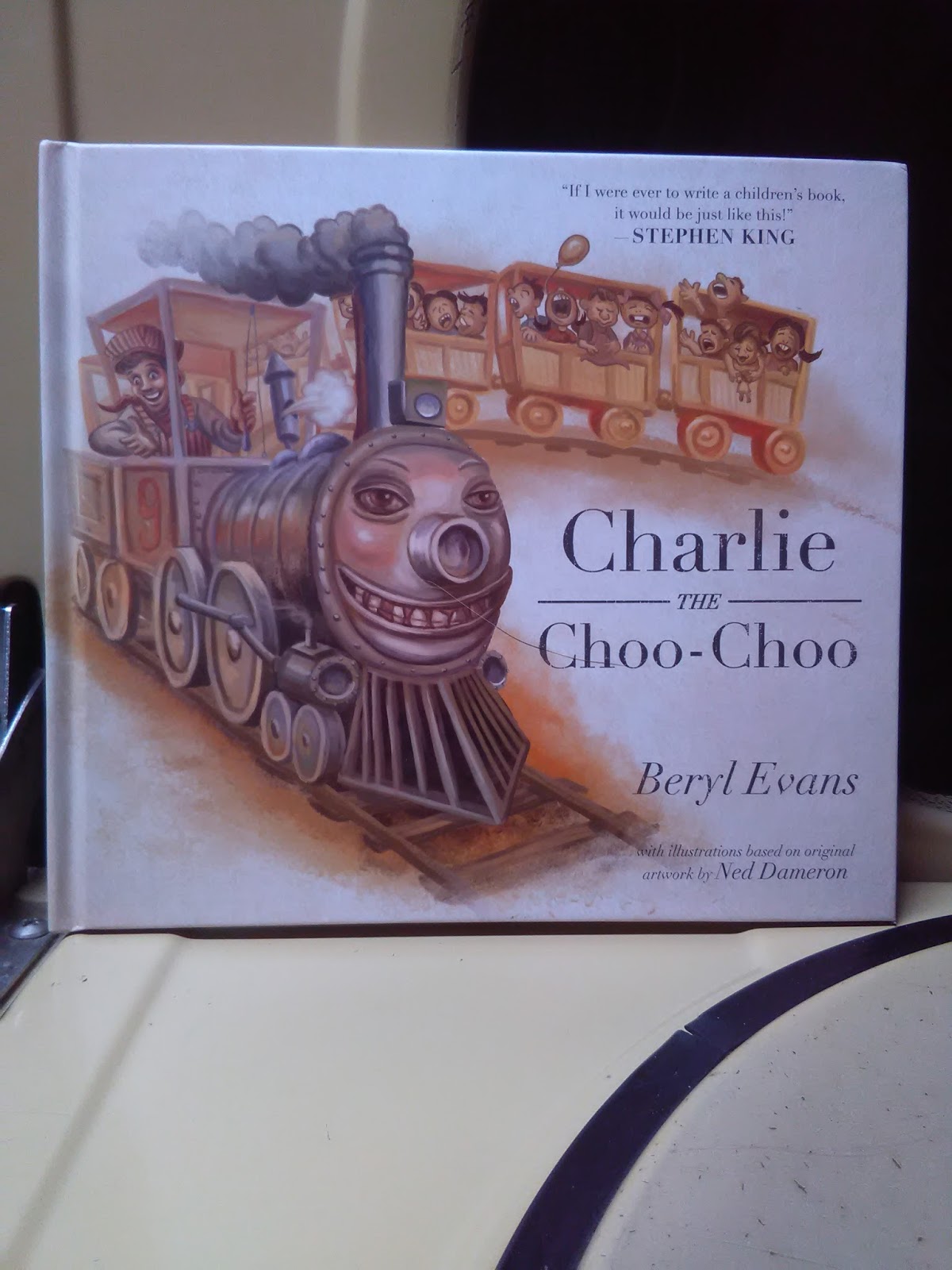
Charlie the Choo-Choo is the story of a little train that wants to get ahead, but it's a children's book written by Stephen King (under the nom de plume Beryl Evans) so it's not exactly a soothing story for a scary night.

Also, everything after this point is a spoiler so if you haven't read the book and don't want the story ruined go ahead and stop reading now. If you DO want to read this blog just highlight the paragraphs below to see them.

 The story as it's written is a very straight little engine that could kind of story - Charlie just wants to do his best and chug along, and he is happy to help out his human engineer.

BUT. But. The book is terrifyingly illustrated, every single image is creepy as fuck and looks like a train that's getting ready to jump off the page and eat the reader. I kept waiting for the book to take a turn, for Charlie to jump the rails and kill every passenger, for his firebox to overheat and explode while his inhuman laughter rattled endlessly through his stack. And it just kept not happening.

Additionally I know that this story takes place in the universe of the Dark Tower and I know that trains in midworld have a somewhat fraught history.

When I finished reading the little book (it took maybe seven minutes the first time, it's a real, legit children's book) I felt a bit lost just because I'd been so nervous through the whole story and suddenly that tension evaporated. It felt ungrounded. I actually really enjoyed the surprise and I think knowing the end is happy will make it easier to appreciate Ned Dameron's wonderfully icky illustrations on future readings. 

This isn't the story I was expecting, but it managed to freak me out in just the way I anticipated.

Cheers,
     - Alli

If you'd like to buy Charlie the Choo-Choo you can find it here.

Wednesday, April 15, 2015

Ever on


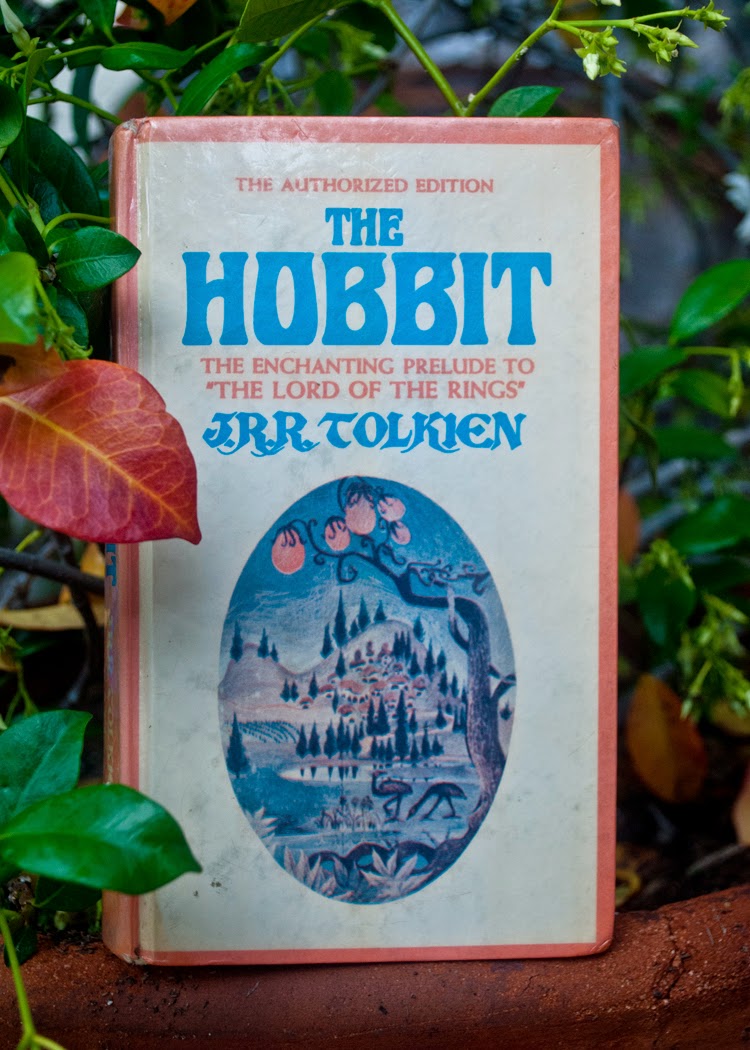
Good books are repeatable. The best books are endlessly repeatable. I don't have any idea how many times I've read The Hobbit at this point in my life but it wouldn't surprise me at all if that number was above fifty.


This time around the novel was even easier than it's always been - I raced through it and it felt like coming home. I couldn't get Middle Earth out of my head after finishing The Silmarillion and so The Hobbit was the next obvious choice (at least in the chronology of the major Middle Earth books). I can't tell if it's just that Bilbo's story is so much easier to read than the tales of the Elves, or if it really is a very simple book, or if I've just read the book so many times now that I don't really have to focus on the words to get into the story. Honestly I don't think it's any of those things - I think The Hobbit was fun and easy to read this time around because I wasn't scrutinizing it the way that I did last time. The movies are out, they're over, I've seen them all, and I don't have to watch out for things to criticize in any upcoming adaptations so I could just let Hobbiton and Mirkwood and The Lonely Mountain wash over me with nothing hovering inside my thoughts but sheer enjoyment of the story.

The book has the same minor problems that it has always had and will always have simply because it was a product of its time and place - it's not terribly representative of anything but white males - but that's no reason to ignore this wonderful story and appreciate it for what it is. It's funny, it's sweet, it's exciting, and it's full of action, adventure, and really wonderful sentiments about friendship and bravery.

The Hobbit isn't a perfect book - I don't know that perfect books really exist - but to me, at least, it will always be one of the best books, and I will always love coming home to it.

Cheers,
     - Alli

Tolkien, J.R.R. The Hobbit. Ballantine Books. New York: New York. 1973. (1937).

Sunday, March 29, 2015

Parenting? What's parenting?

"Hahaha, oh, cousin, we're basically living in an apocalypse! Hahaha!"

The Secret Garden feels like it's got a hell of a lot more lessons for adults than it does for children. It seems to want to teach kids that it's good to explore and play and exercise. It seems to want to teach parents that they're fucking awful and their children run wild and believe in fairies and magic because they've got nothing else guiding them through life.

I had seen the movie but never read The Secret Garden before this week; it makes Mary's parents and Mr. Craven a lot more sympathetic than they are in the book while also making Mary and Colin out to be much bigger assholes than they actually are.

Mary and Colin are great characters, they just both start as scared, reactionary children. The Garden draws them out of their adult-imposed cages and they get to be free and happy and have some agency for once in their fucking lives. That's a really interesting contrast, by the way; both children are used to getting their way in a way that means essentially nothing by ordering around the hired help, but when they do work with their hands and make an actual effort at changing something they grow and change for the first times in their lives.

The language surrounding the Garden is marvelous, by the way. As are the descriptions of Dickon, a poor boy who tames animals and is instrumental in the taming of Colin and Mary. There's a wonderful, sweet magic in the beauty of the garden and the calm control of Dickon - that sweet magic is nearly destroyed when it is described overtly as magic by Colin as he attempts to heal himself; I think if I ever chose to read this book to my kids I might do some slight rewriting so that the wonder of these scenes speaks for itself instead of getting spelled out and thereby breaking its own spell.

Overall I enjoyed this book by I was somewhat frustrated by its flaws, which were so glaring in comparison to the rest of the story.

Cheers,
     - Alli

Burnett, Frances Hodgson. The Secret Garden. Amazon Publishing. Seattle: Washington. 1911.

Sunday, March 22, 2015

Movies always leave out the best parts


I remember being terrified of Mr. Toad's Wild Ride at Disneyland as a child - I rode it before I'd seen the movie, and then once I'd seen the movie I was REALLY terrified of weasels. I got over it and have seen the Disney film a few times, and once (sleep-deprived at 4AM and looking for anything to numb the insomnia) I watched a bizarre, frightening, confusing version of the story done by Terry Jones and what must have been a metric fuckton of acid.

But I'd never read the book until this week and now I'm not at all frightened by any of it, I'm simply charmed by the story and really curious as to why film interpretations of children's books leave out the best and most magical parts.

Everything I've seen has focused on horrible Mister Toad and ignored the sweet friendship of Ratty and Mole. Otter has never gotten his due on screen (that I've seen) and there are a dozen wonderful, not totally lucid, little side-stories that are wonderful to read but get skipped over in favor of motor-cars and Toad dressed as a washerwoman.

This is a lovely, serene little book and I wish I'd read it sooner. If I have kids I'm sure I'll be reading it to them because it's full of delightful little songs and descriptions of cozy holes and spooky woods without being idiotic or insipid the way that lots of children's novels can be.

Though perhaps calling this book a novel is misleading - it seems more like an aggregate of short stories interspersed with chapters of a novella. Mr. Toad's escapades ARE the main action, the greater part of the book, and that's why they've gotten so much attention, but the certainly aren't the best part of the book.

"Piper at the Gates of Dawn" is a fluffy little short story about a lost child and a loving benefactor that made me weep as I read and has established itself in my mind one of the most touching stories of familial love and care that I will ever read. Mole's longing for his hole, Ratty's encounter with a seafaring rat, and stumbling upon Mr. Badger's house in the wild wood are all fantastic moments that are overlooked in a lot of retellings. Not only do they make the book worth reading even if you HAVE seen the movie, it's moments like these that make the book worth reading at all.

Cheers,
     - Alli

Grahame, Kenneth. The Wind in the Willows. Amazon Kindle. Seattle: Washington. 1908.